
Hartford’s Poet for the People
Written by Jeffrey Partridge
To revel in the beauty wrought—
The perfect utterance of a thought.
–Elizabeth O’Rourke Koenig, “I’ve Had My Dreams”
Heart of the Insurance Capital
1920s Hartford presents a hard exterior. We associate 1920s Hartford with business – particularly the insurance business, with its monetary calculations of risks, accidents, and tragedies. Even with art, we associate 1920s Hartford with the modernism of Chick Austin and Wallace Stevens, both of whom became world famous for a kind of art that, despite its own beauty, was for common people as baffling and impenetrable as insurance claims.
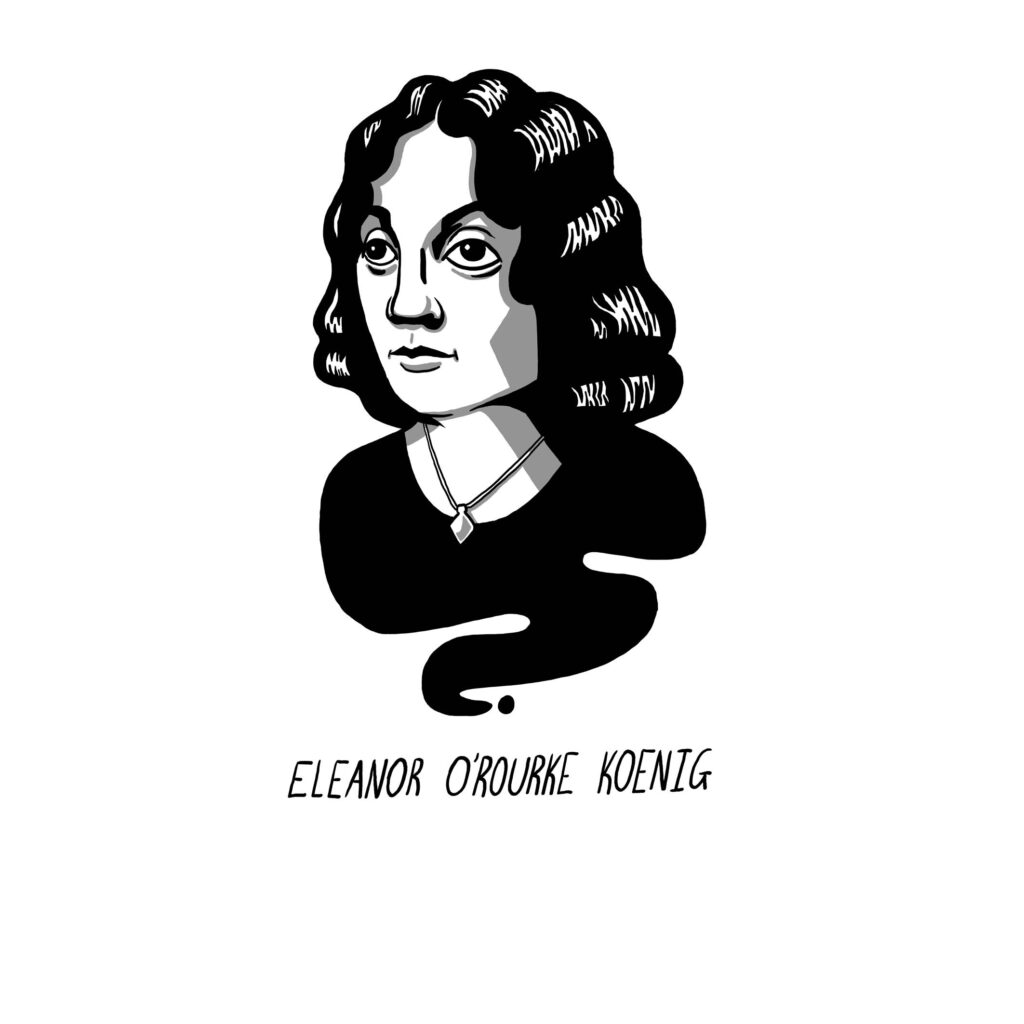
Perhaps we should associate 1920s Hartford as well with Eleanor O’Rourke Koenig.
Koenig was a poet and editor who fashioned a populist burgeoning of poetry in the Insurance Capital of America. She published two books of poetry in the 1920s and attracted attention from Poetry magazine founder Harriet Monroe, Irish Renaissance poet AE, and the towering British novelist Thomas Hardy. Koenig initiated and conducted a twice-weekly column in The Hartford Courant dedicated to publishing poetry submissions of ordinary people and keeping the state abreast of poetry news.
In her eight years as editor of The Poet’s Column, Koenig facilitated the publication of hundreds of poems in The Courant that demonstrate the beating heart of the people – their joys, their hurts, their loves, their fears.
Reviews of her poetry in The Courant suggest that Hartford embraced Koenig as their own. “Hartford cannot forego its claim of pride in her noble talent,” wrote book critic Elizabeth N. Case (Dec 22, 1929). Case congratulated herself on being “one of the first to realize that here, in our own city, was burgeoning one of the high poetic talents of our day” (italics added). Courant writer Julia S. Older noted the contrast between Koenig’s Irish verse and the urban exterior of Hartford, saying, “Hartford she finds a quiet study in which to write verse that has nothing to do with people in cities, modern life or insurance” (Feb 25, 1928).
A Writer of Pure Poetry
Both as editor of The Poet’s Column and in her own verse, Koenig offers the “everyman” reader a pathway to the mystical beauty of poetry. “To revel in the beauty wrought—/ The perfect utterance of a thought”; this line from her poetic reflection on John Keats’ “Endymion” may well express Koenig’s impetus to write. It also defines one of the central pleasures of reading and writing poetry.
A Courant review of Koenig’s second book praises her “pure poetry”: “Here is a book which opens wide – with a generous, welcoming gesture – the gates leading to the realm of pure poetry, and the lover of pure poetry enters in, with a sense of reverent gratitude to the poet” (Courant, Dec 22, 1929). By “pure poetry,” the reviewer has in mind lines like these from Koenig’s much celebrated “After an Old Irish Meter”:
A terrible, terrible grief is this, it seems;
The core of all beautiful things, I think, is frozen now.
Koenig was also praised for the lyric quality of her poetry and its ability to evoke poignant images of nature, as demonstrated in these lines from “Window View”:
A sky so neutral, cloudless as to spill
Meek pathos on the walk that leads a way
Across a field—
Mostly, however, Koenig’s poetry is praised for its Irishness. “Exaltation, in simple language, of simple things seen in a rock-bottom way with all the brooding fancy and humor of an Irish temperament” is how Older describes her poetry. Case describes it as “a poetry with the authentic note of Ireland, with the strangled sob, the bold revealing phrase, the irresistible glamour of the Celtic gift of emotional expression” (Dec 19, 1929). Monroe, whose influential magazine Poetry published several of Koenig’s poems, wrote that her poetry is “like Irish voices lilting over the morning” (Oct 9, 1935).
Piecing Together Her Life Story*
Details of Koenig’s life are not easy to find. Most of what can be pieced together comes from Older’s 1928 biographical piece in The Courant. According to Older, Eleanor Constance O’Rourke (records also indicate Sheehan as her maiden name) grew up in Western Massachusetts, either living with or often visiting her Irish-immigrant grandmother in a humble home in the foothills of Mount Tom in Easthampton. The days spent exploring the woods and streams there gave young Eleanor a special appreciation for nature that would feature prominently in her poetry, and the nights spent by the fireside listening to her elders and the occasional traveler tell stories was another deep influence.
“Come in From the Rain,” which seems to have been a favorite among critics and general readers alike, is based on actual encounters in her grandmother’s house and is a tribute to her grandmother’s Irish hospitality. The title poem for her first volume of poetry, “Herb Woman,” was inspired by a “traveling doctor” who visited her grandmother’s home when Eleanor was ill and prescribed some bitter herbs.
Eleanor attended convent school and later an academy, showing an early interest in poetry. Some of her poems were published in local newspapers when she was in her early teens. Eleanor’s father shared his love for literature with her and she came to adore Keats and Irish poets.
As an adult, Eleonor did “verbatim work” (transcribing speech to written text) for a short period in Boston, where she met William T. Koenig of Hartford. The couple married and settled in Hartford, where Eleanor continued this work. Eleanor and William appear to have had only one child, Eleanor Christine Koenig, and the couple lived at 183 Seymour Street until their deaths.
Feminist Perspectives
The critical emphasis on her Irishness seems to overshadow the feminism expressed in Koenig’s poetry. The dominant theme of “Decree” and “The Road” is empathy for women trapped in marriages with loveless and even abusive men, as in these opening lines of “Decree”:
This thing that you have done to me,
Rankled injustice meetly in my mind,
And long ago I could have turned to flee
“The Road” is an intense verse story of a young wife contemplating escape from her abusive husband. Koenig evokes the paradoxical emotions so common in abusive relationships:
At first, in terror she had almost swooned,
Then came the headlong sorrow for his fault,
Maternal sorrow, as for a spoiled child…
Other poems like “Second Marriage,” “Boccaccio’s Francesca,” and “Conquest” reflect upon the dignity of women who carve out their own space in otherwise limited lives. The short poem “Conquest” envisions a woman in a room she has just swept clean:
Plumb in the middle—
There she would stand
Holding a broom
And the world in her hand.
The Legend of Hartford
Koenig wrote The Legend of Hartford in recognition of Connecticut’s tercentenary celebrations. The poem paints the arrival of European settlers in biblical terms with Thomas Hooker as the central figure: “Crusader, Utopian Dreamer, Puritan Divine.” Throughout the poem, the speaker calls upon the reader to imagine being there at the establishing of Hartford: “Where Hooker preached – think what it must have been/ To have seen this man, to have heard this orator.” The poem culminates in a reflection on the Fundamental Orders establishing governance at the consent of the people and calls on the present people of Hartford, now 300 years later, to be thankful.
The Irish label helped establish Koenig’s place in the literary world, but it may also have erected barriers to her creative ambitions. The one full review of Legend in The Hartford Courant, for instance, is lukewarm toward her poem because of its lack of Irish charm. The critic complains that in Legend Koenig “deserts her natural field” (Dec 29, 1935). Koenig planned two volumes to follow Legend, both related to Connecticut, and one exploring Native American peoples. She was reportedly well on her way to finishing these projects when Legend was published. It appears, however, that these books never saw the light of day.
So Soon Forgotten
Koenig’s Poet’s Column eventually converted from a twice-weekly to a weekly occurrence, and in 1936, soon after publishing Legend, she stepped down as editor. The last mention of Koenig as a poet in The Courant comes in an event announcement in 1941, which says of Koenig, “her Irish dramatic poems and verse dealing with the early history of the state are widely known.”
Koenig appears one more time in The Courant 14 years later: “Mrs. Eleanor Constance Sheehan Koenig of 183 Seymour St., wife of William T. Koenig, died Thursday at Hartford Hospital” (July 9, 1955).
What happened to Eleanor Koenig the “widely known” Hartford poet? Why was her name – once synonymous with the poetry scene in Hartford – now forgotten? There are no articles of remembrance and no tributes from readers.
The opening lines of “Endymion,” the Keats poem Koenig admires in “I’ve Had My Dreams,” is a meditation on the lasting quality of art: “A thing of beauty is a joy for ever” that “will never/ Pass into nothingness.” Perhaps now, nearly a century after this Hartford poet faded from view, the poetry of Eleanor O’Rourke Koenig will be rediscovered and – this time – remain with us.
* NOTE: What little is published about her life reveals a variety of names and contradictory dates – but the Courant’s habit of including the poet’s address in announcements and in death notices verifies this is the same person. Koenig published sometimes as Eleanor O’Rourke Koenig and sometimes as Eleanor C. Koenig. Her obituary, presumably written by a family member, refers to her as Eleanor Constance Sheehan Koenig, and reports that she left behind a brother and sister, both surnamed Sheehan. Case, in emphasizing her Irishness, states she was “born O’Rourke” (1929). The Courant’s full obituary (July 9, 1955) states that she was born in Easthampton, Massachusetts, which agrees with Julia Older’s account based on her interview with the poet in 1928. The obituary states that Koenig lived in Hartford “over 60 years,” which would place her move to Hartford in the 1890s. But this does not align with Older’s account. According to Older’s 1928 article, Koenig was in her early 30’s at the time and had lived in Hartford for “over ten years,” placing her move to Hartford as late as 1917 and her birth around 1895.