
Hartford – “Where I Found my Imagination”
by Frank Mitchell
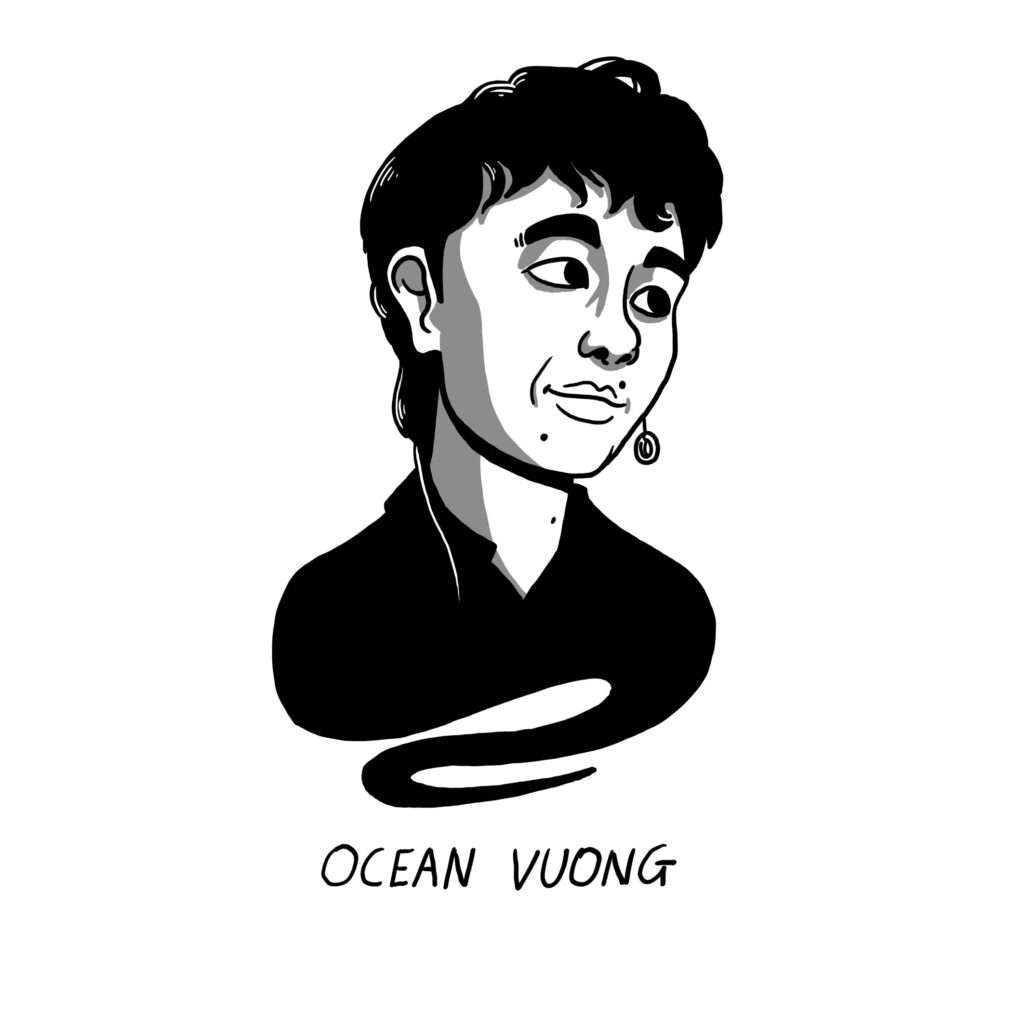
I didn’t realize Connecticut had a reputation, until I left it… and when I went to New York to go to school, when I said I came from Connecticut, everyone said, oh how fancy. And I said what do you mean, and they said well..full of mansions, and private schools, and yachts, and golf clubs. And I thought, gosh where is that happening? That’s not the Connecticut that I knew. And then I realized that so much of the Connecticut formed by immigrants—Jamaican, Haitian, Dominican, Puerto Rican… Chinese immigrants —who worked this land, many of whom worked the agriculture—the tobacco fields.… why is this so invisible? Why is my Hartford so different than Mark Twain’s, and Harriet Beecher Stowe’s and Wallace Stevens’? And how come no one has spoken about that in an honest way? And in a way that doesn’t just denigrate it; it’s also a place where people live, and still live. My family still lives there. And it’s a place where I also found my imagination.
–Ocean Vuong, Where we Live, WNPR, July 8, 2025
Vuong’s 21st Century Hartford
Poet and novelist Ocean Vuong’s tales of immigrant achievement in 21st-century Hartford revise familiar depictions of Connecticut. This Connecticut city is not the landscape of mansions and private schools so often imagined. Vuong’s Connecticut does not appear in television portrayals of The Gilmore Girls’ Stars Hollow, the Westport of American Housewife, the Fairfield of Who’s the Boss?, or even the Judging Amy episodes set in West Hartford and Hartford. This city does not appear in the work of 20th-century, Hartford-born writers Dominick Dunne, John Gregory Dunne, or Jay McInerney.
But this Connecticut does exist and a version of it occasionally emerges. Characters from Vuong’s Hartford might recognize the Wallingford Beverly Donofrio escapes in her teen-mom-as-aspiring-college-student memoir Riding in Cars with Boys. They’ve certainly seen the East Hartford portrayed in William J. Mann’s coming-of-age and coming-out novel Object of Desire, but the Gilmore Girls’ Connecticut is the most dominant portrayal in the public imagination. The neighborhoods and realities navigated by Vuong’s characters are found in cities across Connecticut where many young residents chart paths toward achievement despite economic, cultural, and social obstacles.
Readers and critics discovered Vuong’s Hartford in 2010 with the publication of his poetry chapbook Burnings. Since then, he has continued refining his imagery in a series of award-winning essays, poetry volumes, and novels. This New York Times bestselling author and MacArthur Genius grant recipient writes with a life knowledge of the region’s 21st-century, first-generation, American residents. Vuong claims the city for characters whose life circumstances reflect the realities he has known as well as the people who inspired him to succeed.
The Making of a Poet and Novelist
Born in Ho Chi Minh City (Saigon) to parents traumatized by the Vietnam war, Vuong accepted this circumstance as inspirational lineage for writing and living. By his third birthday, his mother evacuated the family to America through a relocation camp in the Philippines. In Hartford she worked in nail salons and they lived in subsidized housing while the family grew. Their generational history—war, complex citizenship, migration, economic struggle—adds a particular nuance to the story of immigration immortalized in iconic American stories of ascent. The genre includes now classic books like Richard Rodriguez’s Hunger of Memory (1982), along with such contemporary titles as Russell Shorto’s Small Time (2021), Julia Alvarez’s, Something to Declare (1998), and Matt Ortile’s The Groom Will Keep his Name: and Other Vows I’ve Made About Race, Resistance, and Romance (2020).
Vuong’s narrative style integrates his maternal relatives’ oral traditions, his own 21st-century literary instincts, and the history of battles he’s survived. As he explained to podcaster Krista Tippet in an interview days before the pandemic shutdown, “I was surrounded by storytellers, by survivors and storytellers. And so, my grandmother and my mother and my aunt would tell stories to recalibrate their past, to make sense of their past. And my root in the narrative and literary techniques and embodiment begins way before I entered a classroom.”
Vuong’s poem “Beautiful Short Loser,” from the volume Time is A Mother, draws American pop culture, Colt Factory employment, state authority, economic stagnation, personal identity, and family history into the writer’s project of identification.
Now I’m a beautiful short loser dancing in the rain. Inside my head the war is everywhere. Do you think I’ll need a gun where we’re going? Can you believe my uncle worked at the Colt Factory for ten years, only to use a belt at the end?
Later the writer confesses, “I know. I know the room you’ve been crying in is called America.” In The New Yorker essay, “A Letter to My Mother that She will Never Read” — the template for Vuong’s autofiction book On Earth We’re Briefly Gorgeous— he questions, “When does a war end? When can I say your name, and have it mean only your name and not what you left behind?” These battles are familial and national; the characters’ fight to maintain family and they fight for a life outside of it.
Complexities of Upward Mobility
Vuong gained his independence by processing the transition from Vietnam to America. As he grew into the family spokesperson—English proficient, intellectually capable, and American culture savvy—he endured his mother’s fits of frustration at her status. That frustration appeared sporadically in waves of raging aggression. Vuong alludes to this dynamic in the letter as the narrator remembers,
The time I tried to teach you to read the way Mrs. Callahan taught me, my lips to your ear, my hand on yours, the words moving underneath the shadows we made. But that act (a son teaching his mother) reversed our hierarchies, and with it our identities, which, in this country, were already tenuous and tethered. After a while, after the stutters, the false starts, the words warped or locked in your throat, after failure, you slammed the book shut. I don’t need to read, you said, pushing away from the table. I can see—it’s gotten me this far, hasn’t it?
References to the injuries of class and his own experience of class transition due to education and success as a writer are always present for Vuong. “I tried to explain this to my mother, the loneliness of class movement,” he explains in a New York Times Magazine interview with David Marchese (May 3, 2025).
It’s a lot of grief. You enter these rooms [that is, professional settings], and even with my colleagues, they’re all lovely, but it’s hard to explain what we were talking about earlier [in the interview about the trauma of immigrant displacement and poverty]. I never say that stuff, because I feel like it’s going to stop the room. I feel really alone in these spaces, and then when I come home, no one cares.
Kindness, Truth, and Hope
Vuong’s family grew to include a younger brother, and the arrival of his mother’s female relatives meant an extended family even as neighborhood friendships pulled him further into American life. He attended Sunday worship services. He got a summer job working on a tobacco farm. He learned the rules of survival in the fast-food sector of the service industry. He became the Personal Care Assistant for his partner’s grandmother during a break from school—an experience that inspired his 2025 novel The Emperor of Gladness. Wisdom from those years shapes Vuong’s writing and influences his life. In the New York Times Magazine profile he reflects,
We want stories of change, yet American life is often static. You drive the same car, people live in the same apartment, but it doesn’t mean that their lives are worthless. This book—it’s not a spoiler to say that nobody gets a better job, no one gets a raise. So what happens? I’ve been interested in this idea of kindness without hope. What I saw working in fast food growing up in Hartford County was that people are kind even when they know it won’t matter.
The combination of kindness and hope helped Vuong navigate the public networks of support. Hartford, the Insurance Capital of the World, once had sufficient corporate wealth, civic benevolence, and accessible land to offer kindness and hope to needy, new residents and established citizens. So much of the wealth that financed those novice jobs, subsidized neighborhood assistance, and generated community investment had been consumed before the last decades of the 20th century.
That dissolution forced a new network of public resources to respond. Wraparound services at public schools, local public libraries, subsidized housing, community supported youth activities, and the state community college system all had an enhanced role alongside traditional service providers. This assortment represents Ocean Vuong’s Hartford where everyday examples of kindness—and hope—continue to make so much possible. That combination facilitated Vuong’s transfer into Glastonbury schools before his family had secured a local affordable housing unit there.
On a drive with journalist and Glastonbury High alum Kat Chow, Vuong revisits the sentimental landscape of his high school years, noting the academic struggles, the casual bigotry and homophobia, the ubiquitous opioids, the discovery of writing as a refuge, and his need to escape. He admits, “We literally erased ourselves to go to school here… And there was shame with that, too, because I didn’t know how to make use of it. Everyone says, ‘It’s a great school,’ and I was like, ‘I dunno!…I don’t know if it’s that great. I feel like I’m judged before I step into any room…’ (The Atlantic).
In talking with David Marchese for the New York Times he remembers,” My guidance counselor persuaded me to go to community college. My first class there, the syllabus was Baldwin, Annie Dillard, Foucault. And I realized writing was not writing a respectable email to get a job. It was a medium of understanding suffering. That’s when it changed [for me].” From Manchester Community College he transferred to Pace University and then Brooklyn College where he committed to writing. He received his MFA in Poetry from NYU where he now teaches.
The 2025 release of Vuong’s novel The Emperor of Gladness and the campaign supporting it secured his identification as the public intellectual burnished by 21st-century Hartford and representing it with kindness, truth, and hope. With an acknowledgment of Twain, Stowe, Stevens, the Dunnes, and so many other writers that preceded him (the book’s title is an homage to Stevens’ “The Emperor of Ice Cream”), Vuong celebrates this moment in Hartford’s complex history where new residents continue to arrive, identify the obstacles that might impede, and create the necessary pathways.
Ocean Vuong emerges from the intersection of multiple identities evident in contemporary Hartford. His success at integrating them and producing prize-winning literary material from the experience is an affirmation of constant evolution within Connecticut cities and the dedication of new residents to create there.
Anthology Selections
Ocean Vuong: Hartfordian (audio transcript, CT Museum, 2014)
Poetry
Not Even This (Poetry, from Time is a Mother, 2022)
Toy Boat (Poetry, April 2016.)
A Little Closer to the Edge (Poetry, April 2016)
Essay on Craft (Poetry, July/August 2017)
DetoNation (Poetry, February 2014)
Torso of Air (Poetry, from Night Sky with Exit Wounds, 2016)
Essays
Reimagining Masculinity (The Paris Review, June 10, 2019)
Survival as a Creative Force: An Interview with Ocean Vuong (Spencer Quong, The Paris Review, June 5, 2019)
The Weight of Our Living: On Hope, Fire Escapes, and Visible Desperation (The Rumpus, August 28, 2014) Note: includes discussion of suicide.
Beginnings: New York (The Adroit Journal, Summer 2015)
Ocean Vuong – Biographical and Critical Sources