
America’s First Best-Selling Woman Author
Written by Katie Cook
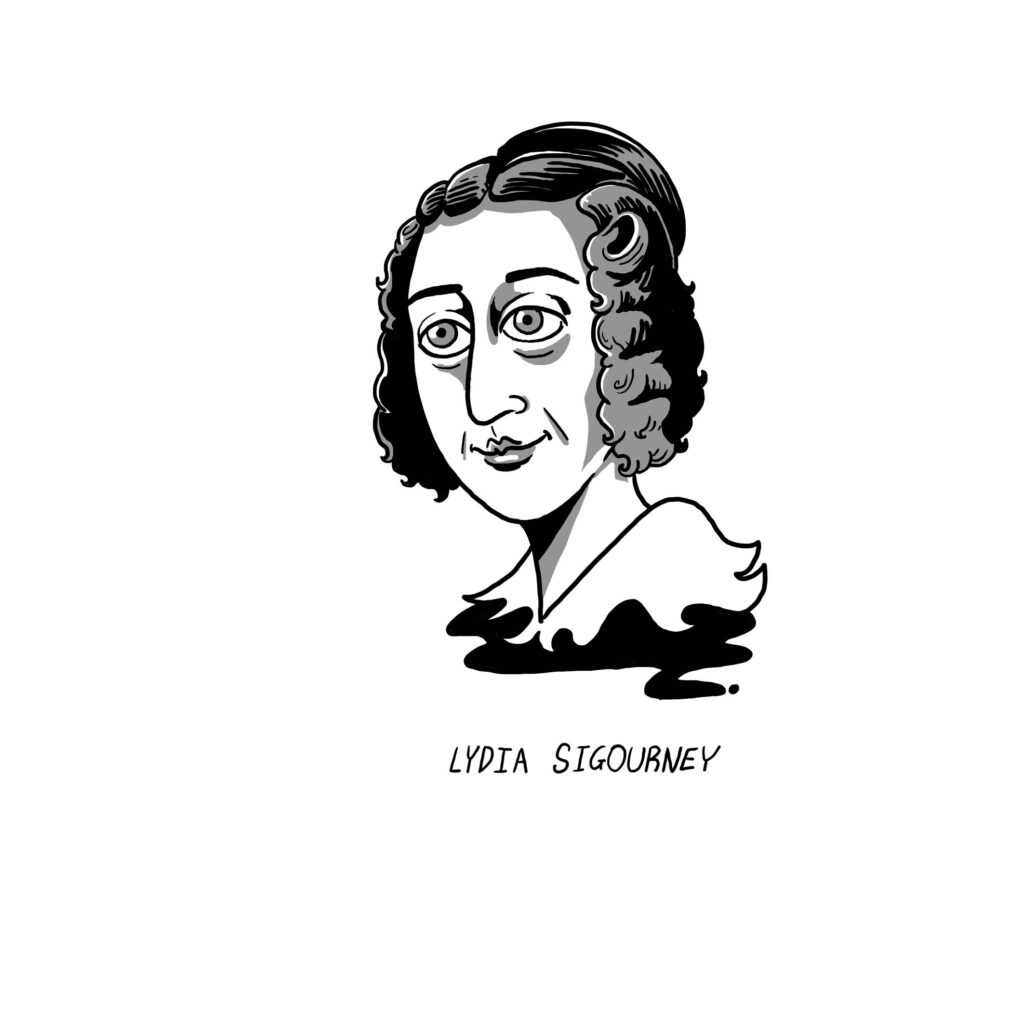
Lydia Huntley Sigourney, born Lydia Howard Huntley on the 1st of September, 1791 in Norwich, CT, was the only child of gardener Ezekial Huntley and his wife Zerviah (Sophia) Wentworth. From a young age, Lydia Sigourney was a champion for women’s education, and in 1814, Daniel Wadsworth invited her to his Hartford home to continue operating her school. In 1815, Wadsworth helped her publish her first book, Moral Pieces in Prose and Verse, marking the beginning of her prolific career as one of the period’s most celebrated writers. By the time of her death in 1865, Sigourney had contributed to over three hundred periodicals and published over fifty books.
During her lifetime, Sigourney was considered one of the United States’ most influential writers and is claimed to be the first best-selling female writer in the nation. However, today her name and works are largely forgotten in both popular culture and academia. In recent decades, some feminist and literary scholars – namely Annie Finch, Nina Baym, and Dorothy Z. Baker – have been reexamining her work and its historical criticisms, rewriting her narrative in a new light.
Humble Beginnings
In her autobiography Letters of Life, Sigourney reflects fondly on her upbringing in a young United States. Her father, a veteran of the American Revolution, would regale his only daughter with stories of both hardship and triumph, which Sigourney cites as making a “strong impression on [her] infantine imagination.” Her father’s garden surrounding the Norwich estate of the dowager Madame Lathrop likewise served as fuel for her poetic vision: “I remember with what wondering reverence I gazed at the tall purple lilacs and white snowballs; my own most familiar acquaintance among the flower-people being the violets and blue-bells and lupines in my allotted plat of ground” (26). Her keen appreciation for nature is evident in many of her works, such as in her poem “Wildflowers Gathered for a Sick Friend”:
Rise from the dells where ye first were born,
From the tangled beds of the weed and thorn,
Rise, for the dews of the morn are bright,
And haste away, with your eyes of light. (1-4)
Sigourney reports finding her love for literature at the age of three, hiding in a trunk lined with printed hymns in her attic, and surreptitiously enjoying her stolen copy of Ann Radcliffe’s Mysteries of Udolpho. Entrusted with an early sense of independence, the young Sigourney found solace in her nightly meditations: “For it sometimes brought me harmonies, and thrilled me to strange delight with rhythmical words.” To Sigourney, it seemed that she had an inherent disposition for the composition of poetry.
The poet’s curiosity was boundless, and her brilliance did not go unrecognized by her father’s well-established client, Madame Lathrop, who insisted on her receiving a substantive education. In her primary years, she attended Norwich’s East District School, later transitioning to the Lathrops’ endowed schoolhouse on the Norwich Green. This tight-knit learning environment fostered Sigourney’s aptitude for higher learning, which she leveraged to teach herself Latin, Greek, mathematics, philosophy, and other subjects that were largely reserved for boys at the time.
The Principled Poet
Sigourney’s unwavering support for women’s education was founded in her belief that men and women belonged to distinct public and private spheres, and that women could best influence society through teaching. In 1811, she and her friend Nancy Maria Hyde opened their school for girls in Norwich, which operated for a few years before Ms. Hyde tragically passed away in 1816. The school’s curriculum was controversial in that it focused on the humanities and natural sciences rather than the domestic arts, deterring many families from enrolling their daughters. Despite this, Sigourney’s school continued to operate until she married Charles Sigourney in 1819, choosing from then on to focus on her domestic duties and career as a writer.
In 1814, amid concerns that the Norwich school would not survive, Madame Lathrop’s friend Daniel Wadsworth – art collector and founder of the Wadsworth Atheneum – offered to let Sigourney operate her school out of his home at 15 Hurlburt St., Hartford. For the next five years, Sigourney’s school stood as a central location for the advancement of young women, including African American, Indigenous American, and other children from underserved communities. Her work inspired other important figures in the movement to expand women’s education, including Harriet Beecher Stowe, Catharine Beecher, and Mary Lyon.
In the same year that the Hartford school opened, a young Alice Cogswell matriculated in Sigourney’s class, studying under the poet until 1817 when she became the first student to enroll in the Connecticut Asylum for the Instruction of Deaf and Dumb Persons (now the American School for the Deaf). Through her instruction of Alice Cogswell, Sigourney became the first known person in the United States to teach a deaf child how to read and write, and a pioneer for deaf education.
Sigourney’s radically inclusive vision for education reflected her spirituality, patriotism, and her passionate opposition to oppression. Through her poetry and other forms of advocacy, Sigourney spoke out against slavery and the mistreatment of Native American peoples.
The Sweet Singer of Hartford
A writer of critical acclaim, Sigourney earned a multitude of praiseful nicknames throughout her career, including “The American Hemans,” “The Female Milton,” and most notably “The Sweet Singer of Hartford.” Her sentimental style and patriotic and Christian values strongly appealed to her 19th-century audience, and the consistency of her publications kept her in the public eye.
Although her husband vehemently objected to female authorship, Sigourney was determined to have her works published, and her success in the field became a financial necessity when her husband’s businesses began to fail. Her most popular poems were initially published anonymously, but were later published under her name in a compilation called Select Poems. Many of these pieces are elegiac and funerary poems, and according to Sigourney herself, were written hastily and extemporaneously. These pieces epitomize Sigourney’s work in the view of most contemporary scholars, painting Sigourney as a shallow, overly sentimental caricature of antebellum women writers. However, Nina Baym, the late American literary historian, argues that Sigourney’s work is far more versatile than it is credited.
Sigourney’s elegiac poetry can be organized into three main subtypes: memento mori, and generic and specific consolation poetry. Her memento mori poetry deals generally with one’s reckoning with mortality and loss, such as her poem “There Is a Time to Die,” which is intended to evoke a sense of comfort about death’s inevitability. The other two subtypes – general and specific consolation poetry – were written to be read by mourners. One such poem, titled “The Lost Darling” was written for a mother grieving the loss of her three-year-old daughter.
Sigourney did not only write poetry and she did not only write about death. Many of her works were conduct books for women – a popular genre during her time which reflected Sigourney’s belief that women had a distinct role in society as homemakers. As its name suggests, these books perpetuated social norms and offered advice for women on how to act in their daily lives. Many of these conduct books were composed as a compilation of letters regarding various topics, such as Letters to Young Ladies, Letters to My Pupils, and Letters to Mothers.
Much of Sigourney’s work, however, focused on history and geography; particularly that of the northeastern United States. She explored these topics extensively in both prose and verse, and her discussion and criticism of worldly matters gave the poet an outlet to connect with the public sphere – without, of course, abandoning her domestic duties. In these historical pieces, Sigourney was able to express her disdain for the mistreatment of African and Native Americans.
While Lydia Sigourney’s work is not widely read today, her legacy as an advocate for the education of women and minorities lives on.
Anthology Selections
Selected Poems
Selections from Zinzendorff, and Other Poems:
“Thoughts for Mourners”
“Garafilia Mohalby”
“Niagara”
Selections from Pleasant Memories of Pleasant Lands:
“The Charter-Oak, at Hartford, to the Great Oak of Geneseo”
“The Great Oak of Geneseo, to the Charter-Oak at Hartford”
“Passage Up the Connecticut, From Hartford to Springfield”
“Letter VII: Manners and Accomplishments” from Letters to Young Ladies
Lydia Huntley Sigourney – Biographical and Critical Sources