
On the Rights of Women and African Americans
Written by Aliyah Freeman-Johnson
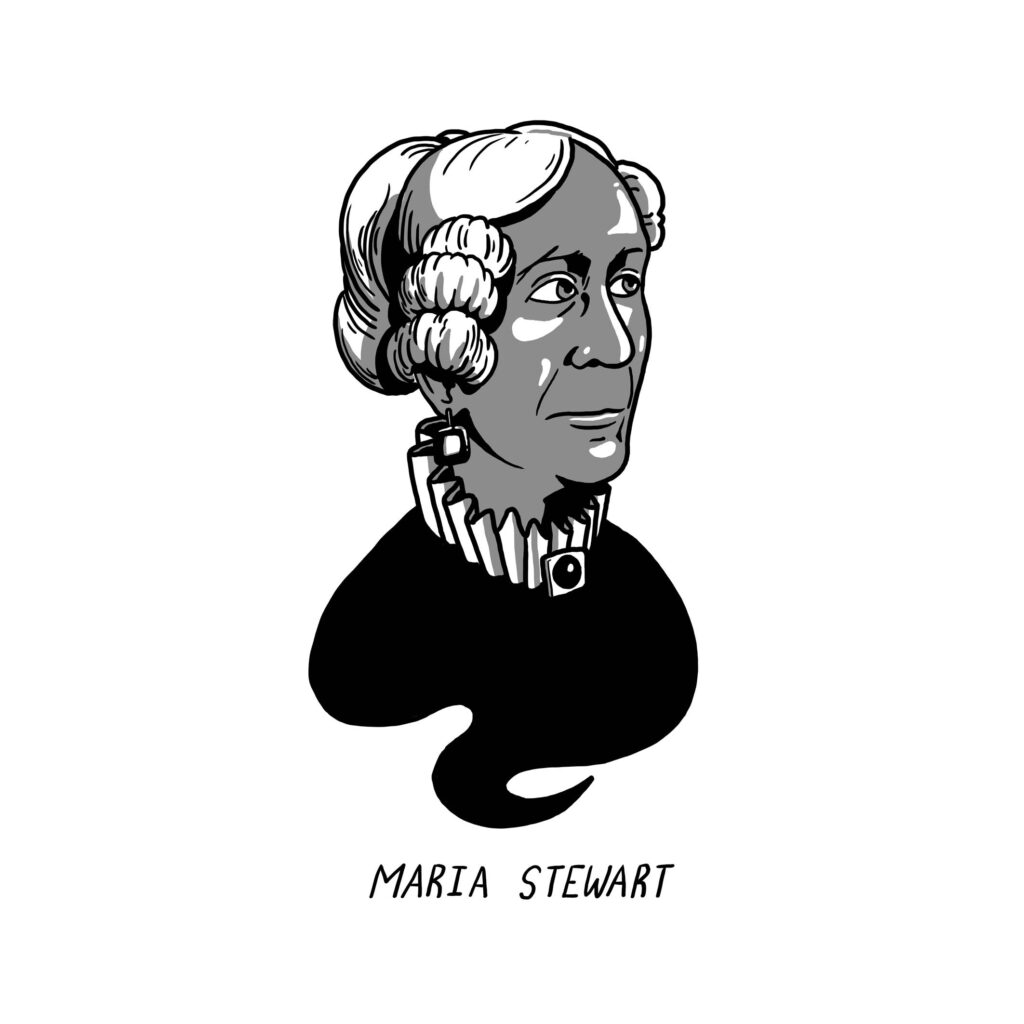
Maria W. Stewart stands as a pivotal figure in both African American history and the women’s rights movement, leaving a profound impact through her groundbreaking activism and advocacy. Her strong commitment to education and personal development informed her views on social justice and equality, enabling her to become a powerful advocate for change. She believed that intellectual growth and self-improvement were essential tools in the fight for racial and gender justice, and she consistently encouraged African Americans, particularly women, to pursue knowledge and self-sufficiency.
Stewart was born Maria Miller in Hartford, Connecticut, in 1803. Her parents were free Black citizens, allowing her to experience freedom during her early childhood. However, at the age of five, she was orphaned and placed into indentured servitude. With limited resources, she served a white minister and his family for ten years. Maria spoke of her early life briefly in her 1832 writing,
I was born in Hartford, Connecticut, in 1803; was left an orphan at five years of age; was bound out in a clergyman’s family; had the seeds of piety and virtue early sown in my mind, but was deprived of the advantages of education, though my soul thirsted for knowledge. Left them at fifteen years of age; attended Sabbath schools until I was twenty. (1832)
Upon relocating to Boston, Stewart became deeply involved in the abolitionist movement, dedicating herself to the fight against slavery. She was a vocal critic of the institution, using her platform to demand an end to the oppression and dehumanization of African Americans. Her dedication to the cause propelled her into public speaking, where she delivered compelling speeches that resonated with diverse audiences.
Challenging Conventions as a Writer and Speaker
Through her writings and addresses, she made significant contributions to African American literature, weaving themes of freedom, justice, and equality throughout her work. She was also one of the first American women, regardless of race, to publicly speak about political issues, breaking societal norms that often silenced women’s voices in public discourse. While in Boston, she married James Stewart sometime in 1826. Just three years later, James would pass away leaving Maria by herself. His passing led Maria further into her faith and into abolition. Against her husband’s intentions, white executors of the law excluded Maria from the will and left her with nothing.
Maria Stewart’s literary contributions span multiple formats, including speeches, poetry, essays, pamphlets, and articles. Her most notable work, Meditations From The Pen of Mrs. Maria W. Stewart (Widow of the late James W. Stewart) Now Matron of The Freedmen’s Hospital, and Presented in 1832 to the First African Baptist Church and Society of Boston, Massachusetts. In September of 1832, she gave the first speech by any woman to a mixed-sex audience. Her works often addressed the importance of moral integrity, self-respect, and perseverance in the face of adversity. She urged African Americans to uplift themselves through education, economic self-sufficiency, and a strong moral foundation, emphasizing that true progress required both individual and collective effort.
Due to public pressure, Maria retired from the speech circuit in 1833 after giving four speeches (Encyclopaedia Britannica 2025). At the time, it was frowned upon for women to give public speeches. Public addresses of any kind were seen as men’s sport and women weren’t a part of the club. This plus growing anger from southern slave owners and supporters made public speech for Stewart difficult at best and dangerous at worst.
An Early Black Feminist
Stewart’s advocacy extended beyond racial equality; she was also a fierce proponent of women’s rights, particularly for African American women. As one of the earliest female activists, she championed gender equality and the empowerment of women, emphasizing the importance of education (African Rights and Liberty 1833). She argued that women should have the opportunity to pursue intellectual and political endeavors just like men.
How long shall the fair daughters of Africa be compelled to bury their minds and talents beneath a load of iron pots and kettles? … Possess the spirit of men, bold and enterprising, fearless and undaunted. Sue for your rights and privileges… You can but die, if you make the attempt; and we shall certainly die if you do not. (1832)
Acknowledging the crucial role of education, she tirelessly promoted access to learning for African Americans, firmly believing it was essential for social advancement. Additionally, Stewart played a vital role in the early Black feminist movement, advocating for the intersectionality of racial and gender justice. Her speeches and writings encouraged women to step out of traditional domestic roles and assert their rights as full and equal citizens. Maria even taught in the South.
Maria Stewart’s Legacy
Stewart’s influence extended beyond her lifetime, as her work laid the foundation for later civil rights activists and feminists. Her courage in confronting societal injustices inspired figures such as Sojourner Truth, Frederick Douglass, Ida B Wells, and later, the leaders of the Civil Rights Movement in the twentieth century. By challenging the status quo and advocating for systemic change, Stewart helped shape the discourse on race, gender, and equality in America. Yet Maria’s work was largely hidden and not taught in classrooms.
Women in the nineteenth century didn’t have access to property rights as they do now. Women could not own or inherit property. Even as widows, the deceased’s land would go to the government, leaving women and children homeless. Frances E. Harper, following in Stewart’s footsteps several decades later, gave a speech called “We Are All Bound Up Together” describing her situation after her husband died, an experience that mirrors Stewart’s.
About two years ago, I stood within the shadows of my home. A great sorrow had fallen upon my life. My husband had died suddenly, leaving me a widow, with four children, one my own, and the others stepchildren. I tried to keep my children together. But my husband died in debt; and before he had been in his grave three months, the administrator had swept the very milk crocks and wash tubs from my hands. I was a farmer’s wife and made butter for the Columbus market; but what could I do, when they had swept all away? They left me one thing and that was a looking glass! (Harper, 1866)
Both Maria and Frances experienced gender and racial discrimination that resulted in losing property once belonging to their late husbands. The laws of the time hit these women, and many like them, at their lowest. Both land and payment were rightfully theirs but were denied them on a technicality of biased laws. This is why of these women fought for both racial and gender equality.
The legacy of Maria W. Stewart continues to inspire future generations of activists striving to address social injustices. Her contributions are recognized within historical narratives, and her work remains relevant in contemporary discussions on race and gender equality. As we reflect on her enduring influence, we celebrate her remarkable contributions and acknowledge their significance in today’s ongoing fight for justice and equality for all. Her life serves as a powerful testament to the enduring impact of education, advocacy, and unwavering commitment to the fight for human rights.
Maria passed away in Freedmen’s Hospital on December 17th, 1879, in Washington DC. She was inducted into the Connecticut Hall of Fame in 2001.
Anthology Selections
from Productions of Mrs. Maria W. Steward Presented to the First African Baptist Church & Society of the City of Boston. (1835)
Introduction (“I was born in Hartford”)
Of Pure Principles of Religion and Morality
Prayer (for the uplift of her people)(1831)
Why Sit Ye Here and Die? (1832)
An Address Delivered Before the Afric-American Female Intelligence Society