
John Gregory Dunne: Novelist, Journalist, Essayist, Screenwriter
by John Christie
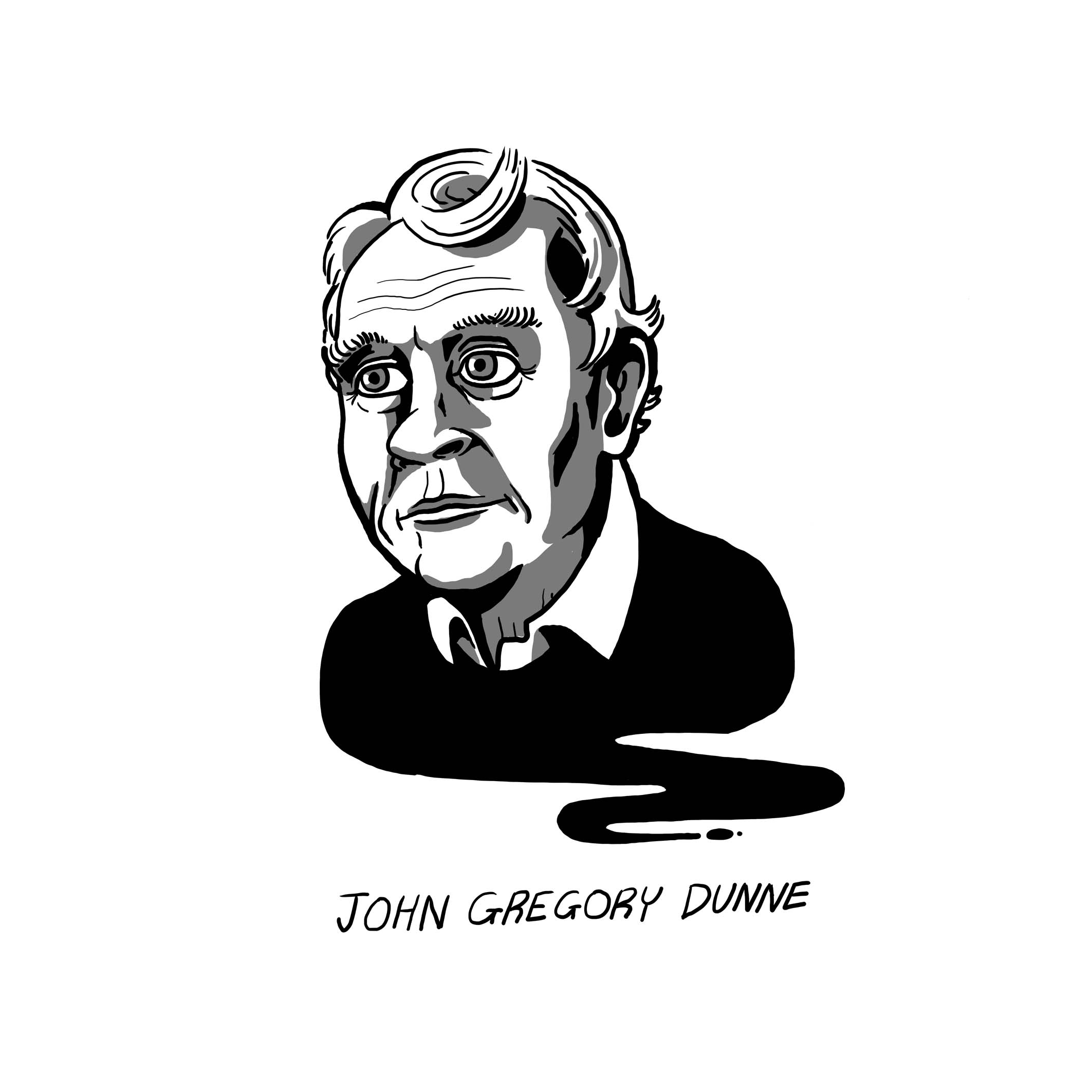
Early life in West Hartford
John Gregory Dunne was born on May 25, 1932 in West Hartford, Connecticut. He grew up with five siblings, three brothers, and two sisters. His father was a well-established heart surgeon in Hartford and the family lived in a large upper-class house off Albany Ave, just across the West Hartford/Hartford town line and within sight of the Hepburn family home (Szanton 2021).
His mother’s father, Dominick F. Burns, had been a successful grocer with a store on Park Street in the Frog Hollow area and had founded the Park St. Trust Co. According to Dunne’s autobiography Harp, his grandfather was considered the first millionaire of the Irish community, “the Saint of Park St.” (39). An elementary school was named after him and still operates as the Burns Latino Studies Academy on Putnam Street. The school’s theater is named after Griffin Dunne, John Gregory Dunne’s nephew, who raised money for it (McNally).
The tenements of Frog Hollow when Burns first arrived constituted the Irish Ghetto from which escape was possible only through the three “P’s”: Politics, Priesthood and Police (Harp 36). No wonder then that John Gregory’s novels, screenplays, and non-fiction articles often probed the undercurrent of law enforcement and the politics and hypocrisies of Catholic institutions.
The wealthy status of the Dunne’s led the Irish family to encourage all the children to enroll in prep schools and private colleges. Yet the writer—far less traditionally Irish Catholic than his parents, especially his mother—always battled with the WASP snobbery of West Hartford, just as he fought to preserve his “harp” Irish working class status (harp being a derogatory term for the Irish purposely reclaimed by Dunne because, as stated on Harp‘s dust jacket, he found it “short sharp and abusive”). Parochial school, John Gregory claims, was “a breeding ground of class hatred” and taught him to be always suspicious of authority (Harp 49).
Despite its affluence, the family was not without traumatic events. Three of the siblings, Dominick, John and the youngest Stephen, all stuttered as children. Overcoming the stuttering was instrumental for John and he often suggested that his turn toward writing was an effort to avoid the difficulties of speaking. In later years, the youngest brother Stephen would commit suicide and a year later John’s sister Katherine would die of cancer. Dominick’s daughter would be strangled to death by a boyfriend.
Dunne enlisted in the military after graduating from Princeton in 1945 and served two years in the army.
Marriage and the move to Hollywood
It was the Dunne family that Joan Didion claims she fell in love with on a visit to Hartford in 1964 when she decided to marry John. John quit his job writing for Time magazine and the two set out on their own, collaborating and writing and sharing their lives, according to the documentary film “The Center Cannot Hold,” created by his nephew Griffin. They moved to California in 1965 and lived in Portuguese Bend, in a house overlooking the Pacific Ocean. It was there that John wrote his first book Delano which documented the California Grape Pickers strikes organized and led by Delores Huerta and Cesar Chavez. When the couple, who could not have their own children, adopted an infant daughter, they moved away from the cliffs on the ocean and rented a large house in a run-down area of Hollywood.
In 1967, Didion wrote about the Haight Asbury “hippies” in her nonfiction work Slouching Toward Bethlehem, its title, like Griffin’s documentary film, taken from the famous Yeats poem “The Second Coming.” It was this book that launched Joan Didion into the stardom she maintained all her life and which John Gregory Dunne shared until his death in 2003. This book and many of the couple’s joint pieces bent the rules for non-fiction writing in the way that Truman Capote’s novel In Cold Blood (1966) had done. This genre of nonfiction known as New Journalism blurs the lines between fiction and non-fiction, the dry facts given the power of literary image, suggestion, nuance, and symbolism so that historical events are made unfamiliar and new.
Though the couple was distanced from the larger Hartford family during the 1970s, Dunne’s brother Dominick moved to Hollywood and worked with them on screenplays. A characterization of the siblings’ relationship may well be drawn from Dunne’s 1977 novel True Confessions: “there had always been strain between them, and fear, and envy. They were brothers. As simple as that. Cain and Abel.” After collaborating on two films, The Needle in the Park (1971), which gave Al Pacino his first starring role, and Play it as It Lays (1972), based on Didion’s novel, the two brothers disconnected.
Dunne and Didion became enmeshed in the Hollywood success of their screenplay for the hit film remake of A Star is Born and Dominick, who covered crime stories for Vanity Fair (including the Menendez brothers and the O.J. Simpson trial), went on to write several popular novels. The brothers reconciled somewhat in later years. According to Dominick, John had a love for the latest gossip, a violent temper, and anything could set him off or provoke the barbs of his Irish humor and sarcasm. In one review of Dominick’s son’s memoir, The Friday Afternoon Club, James Keene recounts a story where Dunne punched Gore Vidal in the face.
Dunne and Didion became unhappy together in the latter 1960s and early 1970s and nearly divorced, and it was during this “dark time” that she wrote Play it As it Lays and he wrote Vegas: A Memoir of a Dark Season. The couple reconciled in a house on Malibu beach which was being partially renovated by the young carpenter and future actor Harrison Ford. There they grappled with Hollywood culture and came together to work on screenplays and articles. Didion’s 1979 collection of essays The White Album explored what both agreed was the meaninglessness of life and writing.
Dunne’s five novels and numerous essays often focused on the underside of Hollywood, characters on the fringes, and his sarcasm reached into the darker side of the Catholic Church’s hypocrisy. As Owen McNally wrote in the Hartford Courant, “everywhere in ‘Dunneland’ there is a loss of innocence,” there is laughter in the tragic and “humor is communion, irreverence is salvation” (2004). His other novels such as Nothing Lost and Playland followed True Confessions with sharp satire, snappy dialog and a twinge of sociological depth, all hallmarks of the crime fiction genre.
Collaboration in New York City
In the early 1980s, Dunne and Didion returned to New York City where they had first met and where, with their weekly joint editorial column, they were dubbed by the Saturday Review, the “First Family of Angst.” They wrote independently but edited each other’s work, and he was the buffer between her and the world of notoriety and fame. He was always her companion and editor. Dunne wrote reviews and articles for countless publications including long pieces in the New York Times Review of Books about, among other topics, the OJ Simpson trial, his friend the actress Natalie Wood, and the baseball great Jackie Robinson. It was the editor of the New York Review who first had steered Joan Didion into her important political writing: Salvador and Miami.
In the long run, neither writer felt restricted by journalistic genres, and they openly celebrated their work together as screenwriters when the general assumption was that such work would jeopardize the creative validity of a true novelist as had been the case perhaps with William Faulkner and F. Scott Fitzgerald. As a couple, they followed their own directions and somehow succeeded in producing a distinguished body of work over a long period of time.
Dunne’s 1997 memoir Monster: Living Off the Big Screen is a testament to the craft and truth-telling that characterized the couple’s screenwriting. The book describes in particularly vitriolic fashion the making of the popular movie Up Close and Personal, starring Michelle Pfiefer and Robert Redford. Didion and Dunne wrote 27 versions of the script that originally traced the tragic life of news anchor Jessica Savage, who died at 36, but the final commercial film wound up censoring Savage’s sexuality, her lover’s abuse, her attempted suicides, and her drug use. The film, in Dunne and Didion’s view, was a total failure.
Death at an early age
John Gregory Dunne died of a heart attack on December 30, 2003 in their apartment in New York City after visiting their daughter Quintana Roo in the hospital. Joan Didion’s National Book Award winning memoir, The Year of Magical Thinking, describes his sudden death in powerful detail and explores her grieving process. Quintana died two years later and Didion documented that tragedy in Blue Nights. Both books, elegant and powerful, reveal more aspects of her husband, John Gregory Dunne, than perhaps anything he himself ever wrote.
Anthology Selections
[In Progress]
Notes for editor:
- A sample column from the Didion/Dunne Saturday Review pieces
- Part 3 of the first pages of True Confessions (pages 8-12). (First pages are too much for high school readers, crude, blunt, not politically correct for sure)
- Chapters 3 or 4 from Harp which talk about the Irish in Hartford.
- An excerpt from any one of his non fiction works other than Harp
John Gregory Dunne – Major Works and Biographical and Critical Sources