
Hartford’s Resident Celebrity
by Beth Burgess
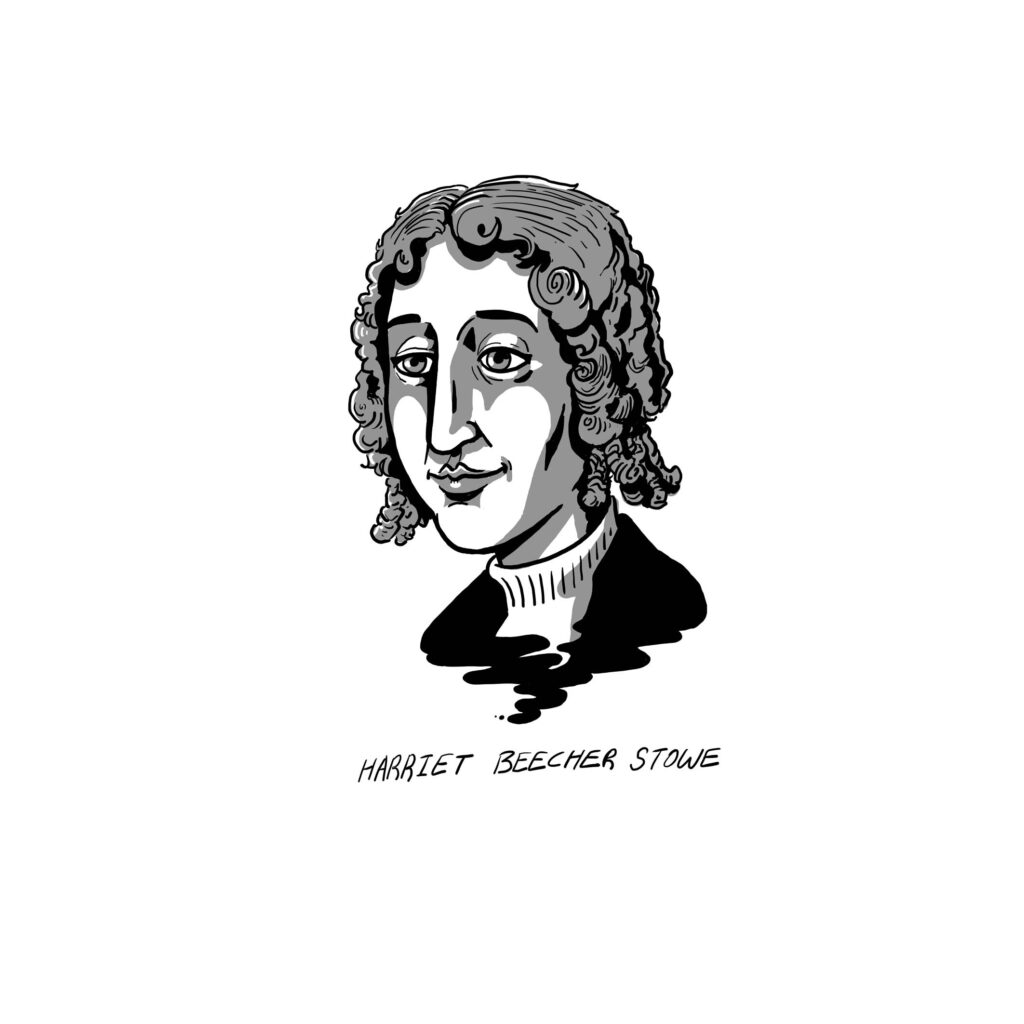
Harriet Beecher Stowe was the renowned author of Uncle Tom’s Cabin, the best-selling 1852 anti-slavery novel that fomented the fight to end slavery in the United States. Internationally famous, Stowe chose Hartford as her home, connecting her Connecticut upbringing with the wealthy Victorian, publishing-capital city of the nation.
From Shy Beginnings: Litchfield to Hartford
Born and raised in Litchfield, Connecticut in the early days of the new Republic, Stowe’s childhood and worldview were framed by Christian faith and morals. Her father Rev. Lyman Beecher D.D. (1775-1863) was a famous Calvinist minister, then pastor of the Congregational Church, who preached against immoral conduct such as dueling, alcoholism, and slavery. Her mother Roxana Foote Beecher (1775-1816) was also well-educated and an artist. As a middle child of a large family, Harriet was smart, quiet and shy, an observer of everything. It was this skill of observation and her privileged education that formed the basis of her writing career.
Harriet first came to Hartford in September 1824, as a 14-year-old teacher of young women almost the same age as herself. Older sisters Catharine and Mary Beecher had opened the Hartford Female Seminary the year before and asked their little sister to come teach in exchange for room and board. Ever the quick study, Harriet learned the course work and taught it, building community with her pupil-friends. Their hand-written school newspaper, “The Gazette”, accessible in the Stowe Center archive, consists of gossip, fake advertisements, religious articles and moral reminders. Later in life Stowe remembered her teenage years in Hartford (1824-1827) fondly, full of sisterly friendship in an idyllic setting.
Interlude – Uncle Tom’s Cabin
In the 33 years Stowe spent away from Hartford, she learned, practiced and honed the craft of writing. Through the genre of parlor literature, a popular women’s writing style using moral suasion and written for a family audience to be read aloud, Stowe built her reputation as an author with short stories, novels, poems, and articles, both fiction and non-fiction.
Written as a weekly serial series over 9 months, Uncle Tom’s Cabin is a novel using the experiences of formerly enslaved people (published freedom narratives and first-hand accounts) as the basis for characters and storylines. Published as a book in 1852, the popular novel broke American publishing records (10,000 copies in the first week and 300,000 by the end of the first year) and cemented Stowe as the preeminent American author. Using her pen as a sword for justice, Stowe’s fiction changed minds and hearts against slavery, arguing that oppressing people was un-Christian, and therefore, wrong. “So you’re the little lady that wrote the book that started this great war” purportedly stated President Abraham Lincoln upon meeting Stowe in 1862. While the veracity of that quote is uncertain, it is a fact that Lincoln referenced Stowe’s Key to Uncle Tom’s Cabin (1853), her compendium of primary source evidence on which her novel was based, when writing the Emancipation Proclamation.
Uncle Tom’s Cabin was appropriated and stereotyped in theater and film adaptations for over 100 years after its publication. The novel is therefore complicated by legacies of racism and is ingrained in American literature and culture both positively and negatively. In the canon of American anti-slavery literature, Stowe’s work stands among the freedom narratives of Frederick Douglass, Sojourner Truth, Harriet Jacobs, and Josiah Henson.
Return to Harford
Meanwhile Old Hartford seems fat, rich & cosy, – stocks higher than ever, business plenty, – everything as tranquil as possible.
– Letter by H. B. Stowe to [Annie Fields], October 1863.
Harriet and her husband Calvin E. Stowe (1802-1886) purchased a residential lot in Hartford’s Nook Farm neighborhood, an upper middle-class community of creators and activists, in the then rural outskirts west of the city ten years before their return. Hartford was an advantageous move for the Stowes, giving them ease of access to potential editors in Hartford’s thriving publishing industry and proximity to a vibrant community of prominent writers and public figures such as Samuel Clemens/Mark Twain, Charles Dudley Warner, and her sister Isabella Beecher Hooker and her husband John Hooker. It is these Hartford years, during the last half of the 1800s, in which Harriet participated in national and international debates and used her reputation to push hot-button topics and influence cultural moments.
Un-gilding an unequal age
I have vowed a vow that I will tell the truth, and as the proverb says, “Shame the Devil,” as soon as I am able.
-Letter by H.B. Stowe to James T. Parton, June 1, 1869
Stowe maintained her Yankee frugality in contradiction to the flaunting of wealth in the late 1800s, a period dubbed “the Gilded Age” by her Nook Farm neighbors Twain and Warner. While building their mansion (“Oakholm”), she wrote House & Home Papers (1864-65), fictionalizing her own struggles with home decoration against the growing consumer goods market (think Amazon or Shein). Harriet suggested that cheaper and trendy carpets, wallpapers, and curtains might be exciting but that tried-and-true basic options and DIY projects were best and promoted middle-class family values. Stowe continued writing on household decoration and management with The Chimney-Corner (1868) and The American Woman’s Home (1869), the latter co-authored with her sister Catharine Beecher.
National debates surrounding racial equity and women’s rights during Reconstruction and following its collapse were not to be missed by Stowe. Once again, from her Hartford writing table Harriet chose her pen to bring awareness to human oppression.
In 1868, she wrote a review for the Hartford Courant in support of activist Anna Dickinson’s What Answer?, a novel about interracial marriage. A few years later Stowe wrote a preface supporting Fanny Stenhouse’s exposé, “Tell It All”: The Story of a Life’s Experience in Mormonism (1872). But these shorter essays do not compare to the power of Harriet’s defense of her British friend Lady Byron, wife of the internationally popular poet Lord Byron, in “The True Story of Lady Byron’s Life” (in The Atlantic, 1869) and the expanded book version Lady Byron Vindicated (1870). Using the proven writing technique that garnered readers’ emotional empathy for her characters, Stowe relayed Lady Byron’s private conversations with her about Lord Byron’s incestuous relationship with his sister and about the couple’s separation. In doing so Stowe hoped to help end misogyny and improve women’s rights via her version of #MeToo. However, audiences were not ready for such scandalous declarations which, at the same time, ‘cancelled’ the celebrated British poet. Stowe’s reputation was forever changed. Subsequent women’s rights novels My Wife and I and Pink & White Tyranny were fictional attempts to regain control of social issues and her respectability without another fall-out.
At the same time, Stowe championed racial equity through education. Working with the Freedmen’s Bureau, a U.S. government-sponsored education program for newly freed Blacks, Harriet coordinated with Mr. J. W. Alvord, Superintendent of Education, fundraising for the construction of a school near Mandarin, Florida in the early 1870s. In a letter to a donor, Stowe wrote,
It has been found expedient – as yet; at the South, to teach the white and black in separate schools. The white children will not come to the same school with the black ones….My little school-house will have to serve for both classes [Black & white], and the thing must be managed with great care, at first. If we are going to soften and modify the prejudices of the white, we must pursue such a course as will induce them to come to our schools, and get them under our influence. (Letter by H.B. Stowe to Miss Wigham, 1869 June 4)
She had a personal stake in Mandarin – the Stowes bought a small home there in 1867 where they wintered in warmer weather, away from Hartford, through 1884.
Once more capitalizing on her own experiences, Stowe wrote a semi-autobiographical Florida series, Palmetto Leaves (1872), with the goal to promote regional tourism, therefore bolstering the local economy. These chapters reveal the limits of her abolitionist beliefs; in them we understand that the same celebrity who advocated for racial equity is also someone who did not see Blacks as equals, particularly formerly enslaved people. African-American characters, such as ‘Old Cudjo’ and Dinah, are based on lazy and uneducated racial stereotypes unable to help themselves (like Topsy in Uncle Tom’s Cabin). Using metaphors to connect the wild natural landscape to formerly enslaved people’s physical strength and aptitude for manual labor, Stowe followed the white trend of backing away from racial equality with the end of Reconstruction. Her reversion to these stereotypes come as a baffling contrast to her bold proclamations against racism.
Safe Nostalgia
Throughout her career of writing for positive change, Stowe also wrote a series of New England novels as a baseline for financial security. These works are happy reminiscences of her childhood experiences, born of a generation just after the American Revolution. Promoting the value of close-knit families and communities, self-reliance and invention, they were easy material for Stowe to produce for a family audience. Old Town Folks (1869), Sam Lawson’s Old Town Fireside Stories (1871), and the semi-autobiographical Poganuc People (1878) are nostalgic, not activist, works of fiction. Sadly, Stowe’s critics were not impressed with recycled plotlines and visiting the past, which Stowe seemed to take in stride, if this reaction to a negative review in The Nation is any indication:
The Nation has come out with a wild mad rave about Old Town folks the general drift of which is that there is nothing in it — not a character and never was in any thing I ever wrote and that they are tired and sick of it and vote it a bore – there’s criticism for you!… (Letter by H.B. Stowe to Annie Fields, May 9, 1869)
When Stowe fell out of public favor in 1869 with the Byron scandal, she easily transitioned to this safe genre. However, by that point, it was too late — the next generation had moved on. Authors like Bret Harte, William Dean Howells, and neighbor Mark Twain’s new masculine-based literature reflected the cultural change of economic and industrial expansion, and the move away from “do-gooding” women authors of the mid-19th century like Stowe.
Harriet Beecher Stowe was a writer whose beginning and end lies in Hartford. From her privileged home and authorial space, she chose to speak out against oppression instead of solely relying on her mainstay literary genres. Her work is not perfect, a product of her white privileges and racial prejudices. Stowe’s struggles to improve society, however, are reflective of our national identity and character — embracing this imperfect union in our own time with hope that our work will benefit the future.
Anthology Selections
Uncle Tom’s Cabin
“Think Not All Is Over,” from Religious Poems
HFS Gazette selection
Woman’s Sphere from The Chimney-Corner, see Reik’s HBS Reader, Stowe-Day Foundation, 1993; pgs. 399-424
The True Story of Lady Byron’s Life
Palmetto Leaves
Poganuc People (excerpts)