
Fighting for the Constitutional Rights of Women
Written by Katie Burton
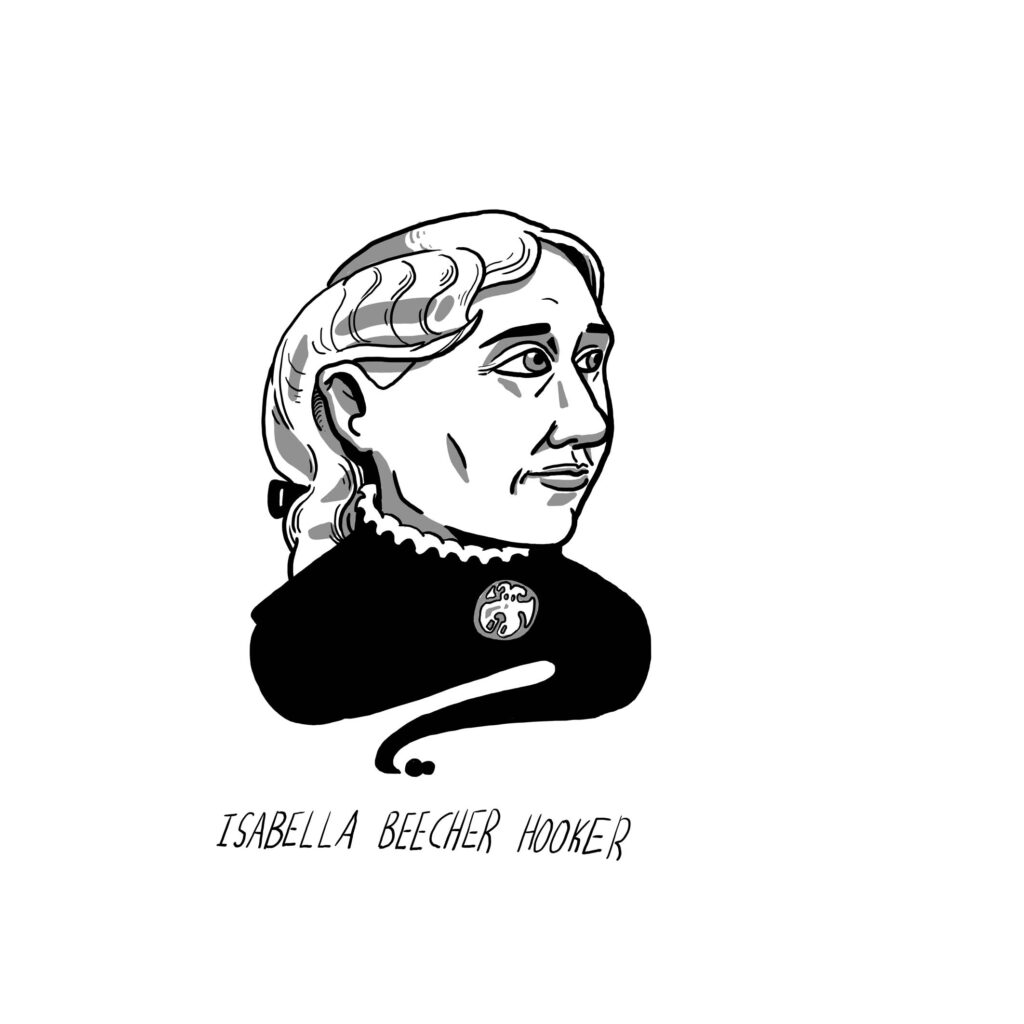
“It is the plain duty of every woman to desire the vote, and of every man to remove the obstacles in her way.”
–Isabella Beecher Hooker, “The Constitutional Rights of Women,” 1888
A Leading Women’s Rights Advocate
In 1870, Hartford resident Isabella Beecher Hooker presented a bill to the Connecticut General Assembly. Co-written with her husband, John Hooker, the bill called for establishing property rights for all married women—“making husband and wife equal in property rights” (“The Last of the Beechers”). The bill was rejected. Undeterred, Isabella reintroduced the bill every year for seven years – until 1877, when it was finally passed. Governor Richard D. Hubbard, a family friend, wrote to Isabella, “Thank yourself and such as you for what there is of progress in respect to women’s rights among us” (Campbell). Isabella’s activism and persistence impacted thousands of women living in Connecticut.
For much of the latter half of the nineteenth century, Isabella was one of the state’s—and nation’s—leading women’s rights activists, evolving into an ever-more radical voice as she advocated for suffrage, property rights, better access to divorce, and public service. She was also an ardent Spiritualist, joining a movement that believed the living could communicate with the dead. Described by author Susan Campbell as a “curiously modern nineteenth-century figure,” Isabella used the power of the written word to address inequities and connect communities. Some of her most notable works were written while living in Hartford, and they were strongly influenced by the family, friends, and neighbors who formed her intellectual communities.
Growing Up Beecher
Isabella Beecher was born in Litchfield, Connecticut on February 22, 1822 to Harriet Porter Beecher and prominent Calvinist minister Lyman Beecher. She grew up with 11 siblings—about half of them significantly older, Lyman’s children with his first wife, Roxanna. The “Fabulous Beechers,” as Lyman and his adult children were known, enjoyed national fame for years, distinguishing themselves as public figures known for ministry, activism, and/or literary accomplishments, and their progressive support for education, abolition, and women’s rights.
As a child, Isabella moved with her family first to Boston and then to Cincinnati. She and her sisters—including older sisters Catharine, a prominent proponent of women’s education and domesticity; and Harriet, who would author the famous anti-slavery novel Uncle Tom’s Cabin—studied subjects like Latin, mathematics, and geography at a time when those opportunities were denied to most girls. Isabella’s mother Harriet, who was sick for much of her daughter’s childhood, died from consumption in 1835. Two years later, Isabella moved to Hartford to live with another older sister—Mary Beecher Perkins—and continue her education at Catharine’s new school, the Hartford Female Seminary. Catharine would later describe Isabella as “formed by nature to take the lead,” with “power to influence others” (Campbell 34). Over the next seven decades, Connecticut was where Isabella would grow as an activist and writer.
Life in Hartford
In Hartford, Isabella met, and, at age 19, married John Hooker, a lawyer and abolitionist. From the outset, their relationship was a partnership: Isabella was determined not to lose her autonomy and chafed at traditional nineteenth-century expectations for married women’s submissiveness; John supported his wife and was himself an activist for women’s rights. They lived in Farmington for twelve years, where they had four children: Thomas, who died as an infant; Mary; Alice; and Edward.
The family relocated to the west end of Hartford in 1853, moving into a new brick Italianate house on Forest Street, where they, along with the Gillette family, founded the Nook Farm literary and art colony, where intellectual engagement and creativity were community affairs. They would welcome numerous prominent authors to the neighborhood over the years, including Isabella’s sisters Catharine, Mary, and Harriet, as well as Samuel Clemens (a.k.a. Mark Twain) and Charles Dudley Warner. The Hookers’ home still stands, directly across from Hartford High School.
During her early years of marriage and motherhood, Isabella struggled with physical pain, anxiety, and depression that recurred throughout her life. She frequently sought relief through hydrotherapy—the “water cure” popular in the mid-nineteenth century—and spent extended stays at spas in upstate New York.
Rising Activism
At the same time, Isabella was, in her private life, becoming increasingly involved in the abolitionism, women’s rights, and Spiritualism movements that offered unique opportunities for female leadership. In her journals and letters to family members, Isabella was a talented writer who candidly shared her feelings and beliefs. By her own admission, her interest in “the woman question” grew rapidly after her marriage. She was particularly outraged at the lack of rights afforded married women: that “the very being or legal existence of the woman is suspended during marriage, or at least is incorporated and consolidated into that of the husband under whose wings, protection and cover, she performs everything” (“The Last of the Beechers”).
Isabella’s beliefs about women’s rights were shaped by her relationships with numerous influential thinkers and activists: her sister Catharine Beecher, a proponent for women’s education who, to Isabella’s chagrin, did not believe women should get the vote; her brother Henry Ward Beecher, who was one of the most famous ministers in the country, known for his support of abolition and women’s suffrage; her husband John, with his strong moral compass, legal mind, and unwavering belief in his wife’s brilliance; and some of the most influential leaders of the nation’s women’s rights movement: Anna Dickinson, Elizabeth Cady Stanton, Susan B. Anthony, and Victoria Woodhull.
It wasn’t until the late 1860s, however, that Isabella turned her energies to the public stage. She co-founded the Connecticut Woman Suffrage Association in 1869. One of her earliest published pieces, “A Mother’s Letters to a Daughter on Women’s Suffrage” (1868), demonstrates her earlier, more conservative approach to advocating for women’s right to vote, insisting on motherhood as a woman’s ultimate purpose. Her writing and speeches became increasingly radical over the decades—reflecting in part the influence of close friend Victoria Woodhull. Famously—or perhaps infamously—Isabella remained so committed to the cause of women’s rights that she spoke out against her brother Henry Ward Beecher when he was accused (by Woodhull) of marital infidelity in a public scandal. Though many of her siblings pleaded with her to support her brother, and some, including Harriet, became estranged from her, Isabella insisted on the importance of advocating for women.
Isabella’s intense personality and willingness to publicly espouse radical viewpoints such as suffrage and Spiritualism, contradicting sharply from established norms of “proper” behavior for women, led some—including members of her own family—to question her sanity. Though we cannot know for sure her mental state, calling a woman insane was an established strategy to discredit outspoken women (see, for reference, “The Yellow Wallpaper,” written by Isabella’s grandniece, Charlotte Perkins Gilman, who was born in Nook Farm in 1860).
On the Constitutional Rights of Women
In 1888, Isabella took one of the largest stages of her life. As an organizer for the March 23, 1888 International Convention of Women, she wrote and delivered a speech that performs a compelling close reading of the U.S. Constitution, arguing that it does NOT, in fact, deny women the vote, and therefore women should claim their right to do so. Women, she insists, “do not mean any longer to submit patiently and quietly to such injustice”:
[I]t makes my blood boil to hear … from the lips of mere boys the assertion that they and their sex alone have the right to make and execute the laws that I and my daughters are to live under; that they are born to rule, and I born to obey … moral corruption will not only continue to prevail, but with an advancing civilization will be steadily on the increase so long as woman is powerless to put down moral evils by the direct use of political power as well as by moral influence. (“The Constitutional Rights of Women”)
This speech solidified Isabella’s influence as an intellectual powerhouse in the suffragist movement—a leader whose compelling advocacy would ultimately allow her to shake earlier controversies and accusations of radicalism.
Isabella’s Legacy
In 1905, reflecting on her legacy, Isabella published an autobiographical article in Connecticut Magazine titled “The Last of the Beechers: Memories on my Eighty-Third Birthday.” She modestly recounts a life marked by impactful activism and intellectual celebrity. Even in the article, though—amidst a clear sense of achievement—Isabella remains focused on the cause: “My lover husband has passed to the Great Beyond, and now I am myself awaiting the beckoning call to join him with glad heart, save for my continued disfranchisement.”
Isabella died in Hartford on January 25, 1907 at age 84, after suffering a stroke days earlier. “Mrs. Hooker,” wrote Francis Trevelyan Miller, the editor of The Connecticut and son of suffragist Jane A. Hull, “has never been a mere spectator of progress, or a plagiarist of yesterday; she has herself been an integral part of evolution. With the achievements of the last century she has in all things kept pace and at many times led the way” (“An Appreciation” 303).
Anthology Selections
“The Constitutional Rights of the Women of the United States: An Address Before the International Council of Women,” Washington D. C., March 30, 1888.
“Shall Women Vote? A Matrimonial Dialogue” (1860)
“A Mother’s Letters to a Daughter on Women’s Suffrage” (1868)
“The Last of the Beechers: Memories on my Eighty-Third Birthday,” Connecticut Magazine, 1905.
Isabella Beecher Hooker – Biographical and Critical Sources