
Out of the Yellow Wallpaper – A Writer for Women’s Independence
Written by Katie Burton
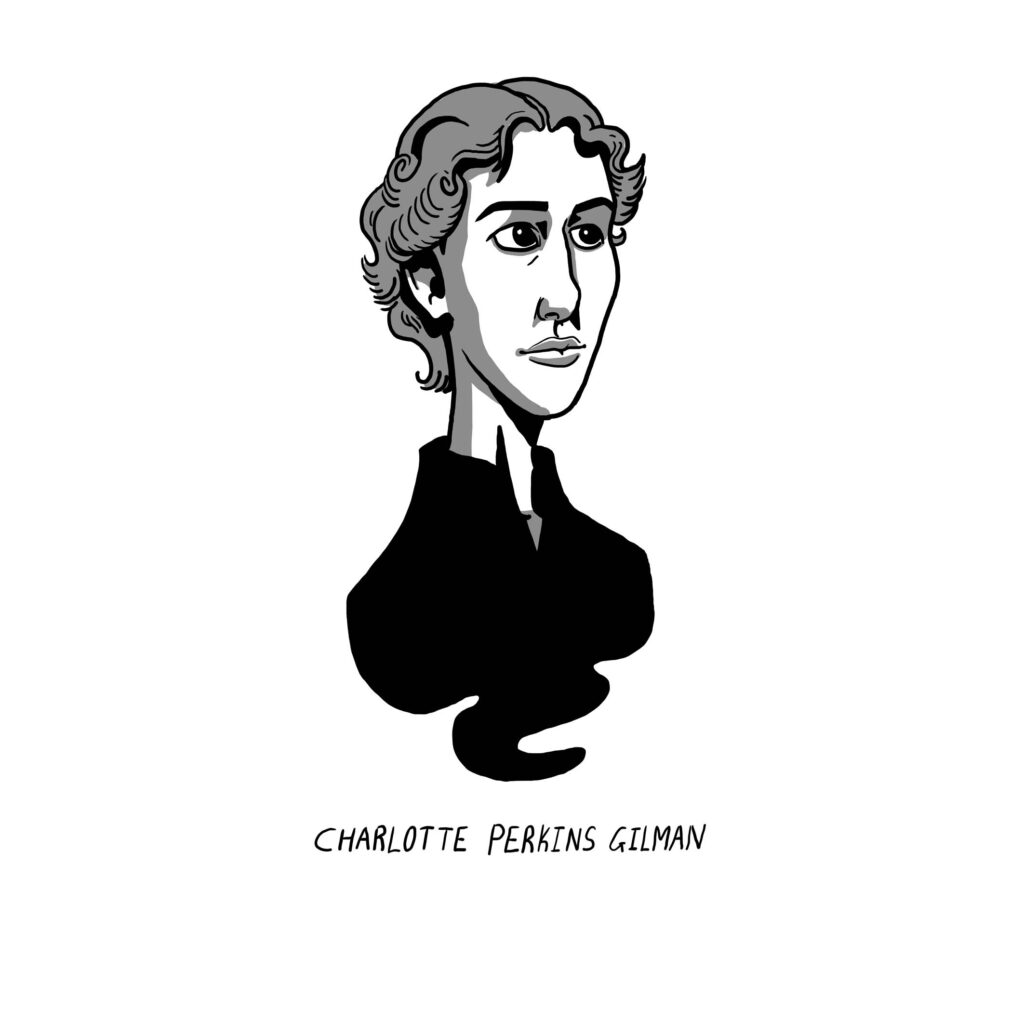
“This world is ours as much as man’s.”
–Charlotte Perkins Gilman, “The Humanness of Women” (c. 1909)
Hartford Beginnings
Hartford native Charlotte Perkins Gilman’s groundbreaking fiction and non-fiction, written at the turn of the twentieth century, rejected traditional gender roles and imagined new possibilities for women. By exposing cruel medical approaches to women’s health, reframing tired arguments about women’s “natural” subservience, and creating vivid depictions of futures free from patriarchy, Gilman pushed literary and social boundaries.
Charlotte Perkins was born in the Nook Farm neighborhood of Hartford, Connecticut on July 3, 1860. Her mother, Mary Fitch Westcott, and father, Frederic Beecher Perkins, separated when she was an infant, and Charlotte and her older brother Thomas spent much of their childhood in near poverty. Without regular financial support from her husband, Mary moved her children frequently, often staying with family and friends for short amounts of time.
In Hartford Charlotte grew up surrounded by some of Connecticut’s most prominent literary and political activists. In the 1860s, the Nook Farm neighborhood was a literary and arts colony where Charlotte’s extended family – including great-aunts Isabella Beecher Hooker, a women’s rights activist; Harriet Beecher Stowe, author of anti-slavery novel Uncle Tom’s Cabin (1848); and Catharine Beecher, a prominent advocate for women’s education – lived and wrote. In her 1935 autobiography, Charlotte emphasized the importance of her family’s influence on her life:
The immediate line I am really proud of is the Beecher family. . . As characters broadened with the spread of the growing nation new thinkers appeared, the urge toward heaven was humanized in a widening current of social improvement, making New England a seed-bed of
progressive movements, scientific, mechanical, educational, humanitarian as well as religious. Into this moving world the Beechers swung forward … (The Living 3)
Though Charlotte moved out of Nook Farm at a young age, she retained a connection to her family’s writerly lineage for her whole life; at age 75, she attributed much of her lifelong literary and political engagement to “the Beecher urge to social service, the Beecher wit and gift of words” (The Living 3).
Emerging Feminist Writer
After leaving Nook Farm, Charlotte spent much of her childhood in Rhode Island. Her formal education was inconsistent. At 18, she enrolled in the Rhode Island School of Design, where she studied art and earned money creating advertising trading cards. While there, she met Martha Luther, a woman with whom Charlotte would have her “first deep personal happiness” (The Living 48). When Martha married a man a few years later, Charlotte wrote that it was “the keenest, the hardest, the most lasting pain I had yet known” (The Living 80). Martha was the first of a few women with whom Charlotte documented close, loving relationships.
In 1882, Charlotte met painter Charles Walter Stetson. He proposed to her early in their relationship and she initially declined, concerned that marriage might limit her independence, but later accepted. They married in 1884, and daughter Katharine Beecher Stetson was born in 1885. Almost immediately after Katharine’s birth, Charlotte began suffering from depression. She chafed at the expectations that society – and her husband – had about a married woman’s subservient role. Charlotte wanted freedom to expand her intellectual and creative goals. In an attempt to ease her increasingly debilitating depression, Charlotte tried to follow Dr. Silas Weir Mitchell’s “rest cure treatment” – a regimen that touted strict routines, bed rest, isolation, and lack of stimulation as a cure for women suffering from physical or mental ailments. The “treatment” was disastrous, plunging Charlotte deeper into depression.
Desperate to find relief, Charlotte separated from Charles in 1888 and moved to California with her daughter, where she lived with close friend Grace Ellery Channing. There, Charlotte experienced a rapid improvement, aligned with an increase in her engagement with local reform movements – including women’s suffrage and socialism – and literary efforts. Over the next several decades, Charlotte wrote prolifically: over a dozen published books, including fiction, nonfiction, an autobiography, and several serialized novels; thousands of lectures, articles, and essays; hundreds of poems; a few plays; and a monthly feminist journal that ran for seven years.
“The Yellow Wallpaper”
In 1890, as a relatively unknown author, Charlotte wrote “The Yellow Wallpaper,” which was published by The New England Magazine in early 1892. The haunting short story describes the suffering of a woman who is likely experiencing postpartum depression: confined to her room, deprived of company and mental and physical activity, she hallucinates that there is another woman trapped behind the wallpaper of her room/prison and descends into madness. With clear echoes of Charlotte’s own experience, the story was a scathing critique of Weir Mitchell’s rest cure. In her own lifetime, the story was a modest success. However, decades after her death, Charlotte’s profound literary vision was “rediscovered” when the Feminist Press re-published “The Yellow Wallpaper” in 1973. The text has since become a seminal example of first-wave feminist writing, canonized during the second wave of feminism of the 1960s and 70s, and a mainstay of feminist literature to date.
In the years following the publication of the “The Yellow Wallpaper,” Charlotte became a well-known author and lecturer, financially independent and at the forefront of the women’s rights movement. She and Charles divorced in 1894, at a time when such action was often socially damaging for women. Theirs was an amicable end, however: Charles went on to marry Charlotte’s friend Grace, and Charlotte, who openly expressed her admiration for Grace’s mothering abilities and the importance of Charles’s paternal rights, initiated a shared custody arrangement for Katharine.
Women and Economics
Though many readers know Charlotte today as a fiction writer, in her own lifetime she reached the pinnacle of her fame as a contributor to feminist economic thought. In 1898, Charlotte wrote Women and Economics: A Study of the Economic Relation Between Men and Women as a Factor in Social Evolution, a bestselling manifesto that was translated into seven languages. Her purpose, she wrote, was to show that “the political equality demanded by the suffragists was not enough to give real freedom. Women whose industrial position is that of a house-servant, or who do no work at all, who are fed, clothed, and given pocket-money by men, do not reach freedom and equality by the use of the ballot” (The Living 235). Women, she explains, must also have economic equality – including a recognition and professionalization of domestic work and the ability to work outside the home. She lectured nationally and internationally, speaking to the power of reform achieved through imagining and effecting new economic realities for women.
While lecturing on the east coast, Charlotte renewed a relationship with her cousin, George Houghton Gilman. The couple married in 1900 and lived in New York City until 1922, when they moved to Houghton’s family home in Norwich, Connecticut. Their relationship was different from Charlotte’s first marriage, as George supported Charlotte’s literary work and public life, and Charlotte was an active writer and lecturer throughout their marriage.
The Forerunner and Herland
One of Charlotte’s notable literary accomplishments during the early twentieth century was The Forerunner, which she wrote, edited, and produced each month from 1909 to 1916. It contained editorials, articles, book reviews, essays, poems, and serialized novels – all written by Charlotte, and many controversial for their progressive ideas about women’s rights. With a peak readership of about 6,500, The Forerunner sought to persuade female readers to advocate for their rights and expose them to ideas that contradicted restrictive ideas about womanhood espoused in conservative publications like Ladies’ Home Journal.
In The Forerunner, Charlotte serialized a feminist utopian trilogy of novels that included Herland (1915). The trilogy, and Herland in particular, immerses readers in a version of the future where women have economic independence – a fictional retelling of her earlier Women and Economics. Charlotte’s feminist futurism is complicated, however, by the limitations of her empathy, as Herland demonstrates support for contemporary racist ideas of eugenics and racial purity. This deeply problematic perspective emerges throughout her literary oeuvre.
Charlotte began writing her autobiography The Living of Charlotte Perkins Gilman in the 1920s. In 1932, she was diagnosed with incurable breast cancer. Her beloved husband died of a cerebral hemorrhage shortly after her diagnosis, and Charlotte moved back to Pasadena, California to live with her daughter and grandchildren. Her lifelong friend Grace joined her. In 1935, Charlotte added a final chapter to The Living, where she described being surrounded by loving family and friends and reflected on her career: “The one predominant duty is to find one’s work and do it, and I have striven mightily at that” (335). Shortly after completing the autobiography, Charlotte died by suicide on August 17, 1935.
Charlotte’s radical writing is noteworthy for its ability to impact and shape two distinct women’s rights movements, separated by almost a century. And though Charlotte – one of the era’s most important writers, philosophers, and reformers – spent most of her life in other states, her familial and geographic connections to Hartford and the Nook Farm neighborhood link her closely to the capital city’s literary community and legacy.
Anthology Selections
“To the Young Wife” (poem)
Herland: https://www.gutenberg.org/ebooks/32 or serialized https://catalog.hathitrust.org/Record/000544186 (but I’d recommend print, see Bendixen above – also contains “The Yellow Wallpaper”)
Women and Economics: https://digital.library.upenn.edu/women/gilman/economics/economics.html
The Living of Charlotte Perkins Gilman: https://archive.org/details/livingofcharlott00gilm
Charlotte Perkins Gilman – Biographical and Critical Sources