
Memoirs of a Hartford Inventor
Written by Lian Kania
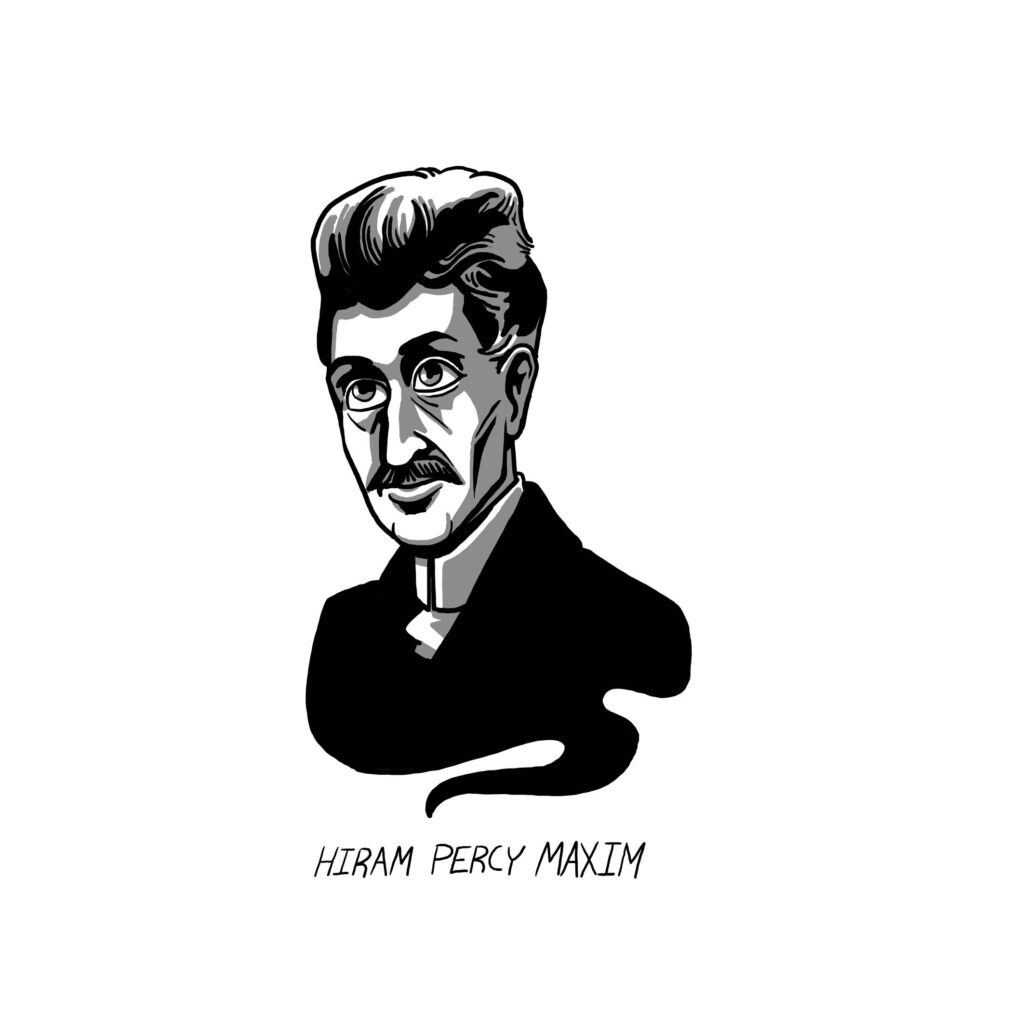
Hiram Percy Maxim was certainly not best known for his literature. The son and nephew of two well-regarded inventors, Maxim seemed destined to become a famous inventor himself. Maxim’s father, Sir Hiram Stevens Maxim, was best known as the inventor of the Maxim gun – an invention for which he was knighted by Queen Victoria. Maxim’s uncle, Hudson Maxim, invented a variety of explosives. Maxim himself invented the silencer. In the realm of weaponry and modern warfare, the Maxims were highly influential.
But the Maxims influenced more of modern life as well. Sir Hiram Stevens Maxim was a key figure in the early development of incandescent light bulbs (he claimed that credit went to Thomas Edison due to Edison’s deeper knowledge of patent law). Hiram Percy Maxim, who primarily grew up in Brooklyn, made his home in Hartford when he started working as an engineer in the motor-carriage department of the Pope Company. In Hartford, he pioneered the gasoline-powered automobile, and his invention of the silencer was also adapted for use on compression engines, eventually becoming mufflers for cars and air conditioners.
Maxim’s clear interest in machines and engineering extended beyond his work. In 1914, Maxim established the American Radio Relay League, the first organized group for amateur radio enthusiasts, and in 1926, he founded the Amateur Cinema League. Maxim’s own amateur film survives in several collections, including a collection at the Hartford History Center at the Hartford Public Library. His films are largely home movies and films of travel, although Maxim did also film and edit short narrative films such as “Mag the Hag: A Dripping Melodrama” featuring his daughter Percy.
Towards the end of his life, Maxim seems to have grown reflective of his life and career. In 1933, he published Life’s Place in the Cosmos, which summarizes what science has to say about the existence of life beyond Earth in a “conversational manner” for the “nontechnical man and woman” (Maxim 1933, vii). Maxim then turned to the memoir. In 1936, the year of his death, Maxim published two memoirs: Horseless Carriage Days about his role in the automobile industry (initially published in three installments in Harpers Bazaar) and A Genius in the Family about his father.
A Genius in the Family
As the title suggests, A Genius in the Family is written through the lens of a son in awe of his father. The memoir is likely Maxim’s most popular book, having been turned into a movie entitled So Goes My Love in 1946. The book begins when Maxim is four and tells stories of Maxim’s childhood in Brooklyn and New Jersey, as well as a few trips to his father’s home state of Maine.
The memoir largely recounts stories of his father’s pranks, through which we see Maxim’s father’s attitudes towards religion, justice, and education. While Maxim’s tone is humorous, his stories reveal his father to be an intelligent but sometimes cruel and condescending man. For every story where Maxim’s father seeks to right an injustice (such as when he tracks down a man who has ripped off a servant in his household), there is a story where he plays with the emotions of people around him as if they were test subjects (such as when he goads a man who has come to his door for “Christian charity” into praying for his record player to stop to prove that prayer does not work).
These stories also clearly show how a fascination with engineering was passed down from father to son. Maxim recounts how his father talked to him as if he were an adult throughout his childhood and teased him for not understanding adult vocabulary or scientific principles. While some of these stories come off as mean, Maxim tells these stories fondly, offering them as examples of how life with his father instilled in him a curiosity and love of machines.
Maxim reveres his father throughout the memoir, yet he notes that his father was remarkable because of his genius and not because of his great parenting skills. To open the memoir, Maxim writes, “I suspect I had one of the most unusual fathers anybody ever had. I was his firstborn. He knew considerably less than nothing about children and he had to learn how to be a father. He learned on me” (Maxim 1936, 1). After recounting story after story of his father’s pranks, Maxim concludes, “He had a brilliancy which sparkled, a masterful cleverness and resourcefulness that placed him above any other man I ever knew. But he never quite learned how to be a father” (Maxim 1936, 193).
Invention and Wonder at the Changing World
In Horseless Carriage Days, Maxim writes about his own genius in the “pioneer days” of the automobile industry with the aim of ensuring that “their atmosphere may not fade entirely from the memory of man” (Maxim 1937, xi).
Maxim’s book captures the atmosphere of the horseless carriage days. He keeps his notes about the engineering process to a minimum, focusing instead on memorable stories about the first motor track race in America (held in Branford, in which there were only two contestants: Maxim’s Mark VIII and the Stanley Steamer), tales of sabotage, and the surprising story of how Henry Ford busted the Selden Patent for a gasoline-powered engine, an action that contributed to Pope Manufacturing’s failure in 1914.
Throughout the book, Maxim is struck by how much technology has changed within his lifetime. Following his ambitious expedition from Hartford to Saybrook in his gasoline-engine tricycle, Mark VII, Maxim notes, “I was the most optimistic of the optimists in 1897, but even I never dreamed motor-cabs, motor-wagons, motor-trucks, motor-buses, and private motor-cars would be used in the millions, as they are today” (Maxim 1937, 104)
Maxim’s wonder at how the world had exceeded his vision mirrors an episode in A Genius in the Family in which Maxim recounts a memorable argument between his father and his father’s employer, Mr. Schuyler, about the possibilities for electricity. Maxim recalls,
…Mr. Schuyler became prophetic. Said he, “Maxim, you may say what you like, but I can see the day coming when electricity will be generated in large gasworks today and distributed through the streets for house lighting.” To this my father shook his head and replied, “No, Schuyler. You are looking too far ahead. Such a day may come; but there are too many unsolved technical problems for me to believe it will be in our times.” (Maxim 1936, 159-160)
Maxim later asserts that “Both Mr. Schuyler and my father lived to see the day when Mr. Schuyler’s prophecies came true a thousand times over” (Maxim 1936, 165).
As he looks back on his life, Maxim’s writing is tinged with nostalgia. While Maxim lauds the great leaps made in technology during his lifetime, his writing aims to transport the reader to a time when this technology was not ubiquitous. As he concludes Horseless Carriage Days, he says, “Today the ability to [drive] is taken for granted; a motor trip has become as prosaic as a ride in a railroad train. All the hopes and ambitions of 1893 have been realized; but with their realization the sparkle and the thrill have departed” (Maxim 1937, 175). As we become increasingly dependent on technology, Maxim reminds us of the importance of holding on to the enthusiasm and wonder of a visionary.
Anthology Selections
Hiram Percy Maxim – Biographical and Critical Sources