
“Sketches of American Policy”: Road Map to the United States Constitution
by Jeffrey J. Mainville
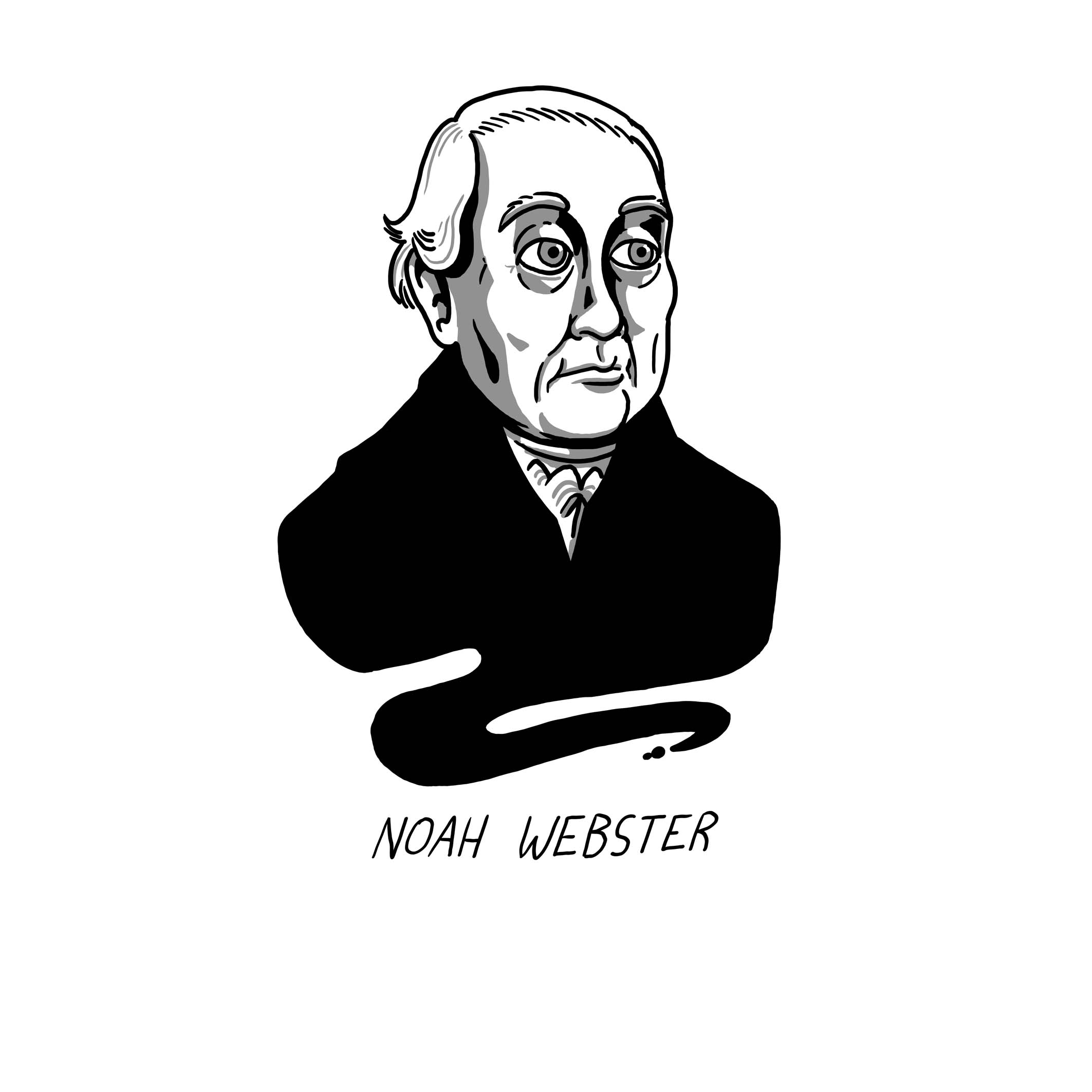
I wish to enjoy life, but books & business will ever be my principal pleasure. I must write—it is a happiness I cannot sacrifice.
–Noah Webster, Letter to George Washington, Dec. 16, 1785.
Early Years: Hartford and Yale
Noah Webster’s remarkable life began in 1758 on a simple farm in the “west division” of Hartford, Connecticut; both parents could trace their lineage back to former Connecticut governors, and his father, Noah Webster, Sr., was an important contributor to the small community, serving as Captain in the local militia and as a Deacon in the church. His mother, Mercy Steele Webster, taught her five children to read, write, sing and play the flute. Evenings were spent in the “best room” of the small house as his father read from the Bible, or listening in on the gatherings of local men who came by the Webster home to discuss the issues of the day.
Life on a farm did not suit young Noah; he was a studious child and much preferred to read his books than to work in the fields. He showed exceptional promise as a student and was tutored by the Reverend Nathan Perkins, who recommended that the boy continue his studies at Yale College. Noah, Sr. mortgaged the farm to pay the tuition and Webster departed for his first semester in New Haven in 1774 at the age of 16.
Yale’s Class of 1778 is notable for several remarkable graduates; some of Noah Webster’s college chums included Joel Barlow, the Revolutionary War-era poet and statesman, and Oliver Wolcott, Jr., who succeeded Alexander Hamilton as the new nation’s second Secretary of the Treasury under President George Washington. Classes at Yale were moved inland on at least two occasions during Webster’s four years there as British forces threatened to attack the harbor city during the early years of the American Revolution.
From “The Blue-Backed Speller” to “Sketches of American Policy”
As the war for American independence dragged down the economy, neither Webster nor his father could afford to pay for more schooling; a career in law would have to wait. In 1779, he accepted a position in Hartford teaching school but discovered that conditions in the classrooms were mostly unsuitable for learning. He set about to develop a new curriculum tailored toward American students and to create lessons that were more interesting and more effective. Webster’s methods produced improved results amongst his students, and by 1782 he was compiling his lessons into the American Spelling Book. Webster’s marketing savvy and constant revisions kept sales ticking upwards each year, and the “Blue Back Speller,” as the textbook was commonly known, sold an estimated 60 million copies in his lifetime. Historian Harlow Giles Unger described the impact of the little schoolbook on American education in this way: “It made every previous speller obsolete and gained a virtual monopoly in American classrooms for more than a century. No book other than the Bible would ever reach as many Americans…it created a new language for a new nation and ensured that all Americans would speak alike” (Unger, 45).
In 1781, the surrender at Yorktown of British General Cornwallis’ army to American and French forces resulted in the cessation of major hostilities during the war, yet a Tory publication named the New-York Packet still insisted that continuing to fight the British was “folly” and that the colonists should rejoin peacefully with the parent country. Noah Webster was motivated to respond in the press with his “Observations on the Revolution in America”, a rebuttal that argued, “King George had forfeited all right to the allegiance of the American people by imposing ‘unconstitutional and oppressive laws’ and confiscating property” (Unger, 42).
As the popularity of the The American Spelling Book continued to grow after its publication in 1783, cheap imitations began to appear on the market, hardly bothering to conceal their theft of Webster’s intellectual property. Copyright laws in America were almost non-existent in the 1780s, as the federal government had little ability to protect authors under the Articles of Confederation. During the earliest years of the new nation, much of the power resided with the individual states. Webster’s solution was to support the “federalist” party and advocate for centralized power in America. “Sketches of American Policy” was published in 1785 and outlined his proposal for a strong, new federal government. He based much of his framework on the Connecticut constitution, a document that he claimed was “the most perfect on earth” (Unger, 88).
Sketching a Political Road Map
With his sharp intellect, incredible persistence, and help from his acquaintances at Yale College, Noah Webster had managed to meet and regularly correspond with some of the most important men in America, such as George Washington, Benjamin Franklin, James Madison, and Alexander Hamilton, all before he was thirty years old. “Sketches of American Policy” began to make the rounds as a solid blueprint for what would come four years later.
Virtually every educated man in America who participated in the affairs of government read Webster’s “Sketches,” and the framers of the Constitution incorporated almost all its principles in the framework they created for the new American government. Although ignored by most historians, Webster’s “Sketches” preceded by two and a half years the publication of the Federalist Essays (1787-1788) and both Alexander Hamilton and James Madison borrowed almost all of Webster’s concepts for their essays. (Unger, p. 83)
Webster would again wield his pen in 1787 to help shape public opinion with “an earnest desire to be useful to my country.” On October 17th (the day after his 29th birthday) he would publish “An Examination into the Leading Principles of the Federal Constitution: Proposed by the Late Convention Held at Philadelphia, with Answers to the Principal Objections That Have Been Raised Against the System, by a Citizen of America.” In this essay, he speaks directly to the American people, asking them to read the new draft of the proposed Constitution and urging them to support its adoption: “it is not only the right, but the indispensable duty of every citizen to examine the principles of it.” In the essay, Webster summed up the strengths of the proposed constitutions as follows:
Let us then consider the New Federal Constitution, as it really is, an improvement on the best constitutions that the world ever saw. In the house of representatives, the people of America have an equal voice and suffrage. The choice of men is placed in the freemen or electors at large; and the frequency of elections, and the responsibility of the members, will render them sufficiently dependent on their constituents. The senate will be composed of older men; and while their regular dismission from office, once in six years, will preserve their dependence on their constituents, the duration of their existence will give firmness to their decisions, and temper the factions which must necessarily prevail in the other branch. The president of the United States is elective, and what is a capital improvement on the best governments, the mode of chusing him excludes the danger of faction and corruption. As the supreme executive, he is invested with power to enforce the laws of the union and give energy to the federal government.
Webster was skilled at shoring up endorsements for many of his writings before launching publicly, and for “Sketches” he went right to the top. He sought the approval of George Washington, who marked up a copy with passages that Webster should “publish in the national press,” along with a letter asking if the young teacher would come to Virginia to serve as a tutor to the children at Mount Vernon. Webster politely declined, citing his desire to someday be married, and also to concentrate his efforts on his scholarly pursuits. “I wish to enjoy life, but books & business will ever be my principal pleasure. I must write—it is a happiness I cannot sacrifice.”
A Lasting Legacy
Many of Noah Webster’s most significant writings have been overshadowed by the work he would become most known for, the monumental American Dictionary of the English Language (which took him 22 years to complete, publishing the landmark tome in 1828). His speller and dictionary were extraordinary accomplishments, establishing the uniqueness of American English forever. Yet decades prior, his inexhaustible desire to make meaningful contributions to society and his fierce patriotism led him to take on significant political challenges as his confidence grew in the power of his pen. “Sketches of American Policy” remains an influential and important work that greatly contributed to the framework of the United States Constitution.
Anthology Selections
Sketches of American Policy, Essay 4. (1785)
Noah Webster – Biographical and Critical Sources