
An armorer is a manufacturer of firearms. There is no real “St. Armorer.” Stevens got the idea for him from the Church of the Good Shepherd on Wyllys Street in Hartford. This church was built to honor Samuel Colt, the wealthy manufacturer of firearms—most famously the Colt pistol—who lived in Hartford. It is now part of Coltsville National Historical Park. The most striking aspect of this church is the Armorer’s Porch which features Colt pistols and other gun parts carved into its façade (see photos below).
Stevens places his St. Armorer’s Church in France. (Notice the French words in the poem: “Terre Ensevelie,” “en voyage,” “vif.”) The time is just after World War II and the church is in ruins, like much of Europe. It is a symbol of the past, of old ideas that are outdated or have been destroyed. In its place, Stevens imagines a “chapel of breath,” a living site of rebirth and hope for the future.
St. Armorer’s Church from the Outside
by Wallace Stevens
St. Armorer’s was once an immense success.
It rose loftily and stood massively; and to lie
In its church-yard, in the province of St. Armorer’s,
Fixed one for good in geranium-colored day.
What is left has the foreign smell of plaster,
The closed-in smell of hay. A sumac grows
On the altar, growing toward the lights, inside.
Reverberations leak and lack among holes . . .
Its chapel rises from Terre Ensevelie,
An ember yes among its cindery noes,
His own: a chapel of breath, an appearance made
For a sign of meaning in the meaningless,
No radiance of dead blaze, but something seen
In a mystic eye, no sign of life but life,
Itself, the presence of the intelligible
In that which is created as its symbol.
It is like a new account of everything old,
Matisse at Vence and a great deal more than that,
A new-colored sun, say, that will soon change forms
And spread hallucinations on every leaf.
The chapel rises, his own, his period,
A civilization formed from the outward blank,
A sacred syllable rising from sacked speech,
The first car out of a tunnel en voyage
Into lands of ruddy-ruby fruits, achieved
Not merely desired, for sale, and market things
That press, strong peasants in a peasant world,
Their purports to a final seriousness–
Final for him, the acceptance of such prose,
Time’s given perfections made to seem like less
Than the need of each generation to be itself,
The need to be actual and as it is.
St. Armorer’s has nothing of this present,
This vif, this dizzle-dazzle of being new
And of becoming, for which the chapel spreads out
Its arches in its vivid element,
In the air of newness of that element,
In an air of freshness, clearness, greenness, blueness,
That which is always beginning because it is part
Of that which is always beginning, over and over.
The chapel underneath St. Armorer’s walls,
Stands in a light, its natural light and day,
The origin and keep of its health and his own.
And there he walks and does as he lives and likes.
Glossary
Terre Ensevelie: “buried earth”
Matisse: Henri Matisse, the most famous French painter of the twentieth century
Vence: a small town on the French Riviera. Matisse designed and built his Chapel of the Rosary there.
en voyage: “while traveling”
vif: “lively,” “alive”

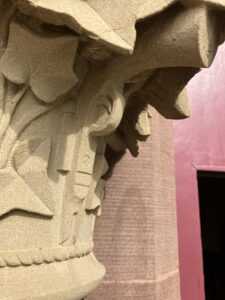
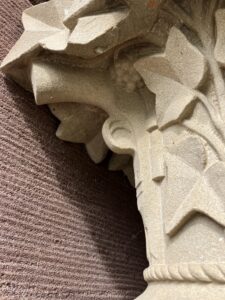

Photos courtesy Jack Hale, Church of the Good Shepherd
“St. Armorer’s Church from the Outside” from THE COLLECTED POEMS OF WALLACE STEVENS by Wallace Stevens, copyright © 1954 by Wallace Stevens. Used by permission of Alfred A. Knopf, an imprint of the Knopf Doubleday Publishing Group, a division of Penguin Random House LLC. All rights reserved.