
Editor, Popular Writer, and One-Time Co-Author with Mark Twain
by James Golden
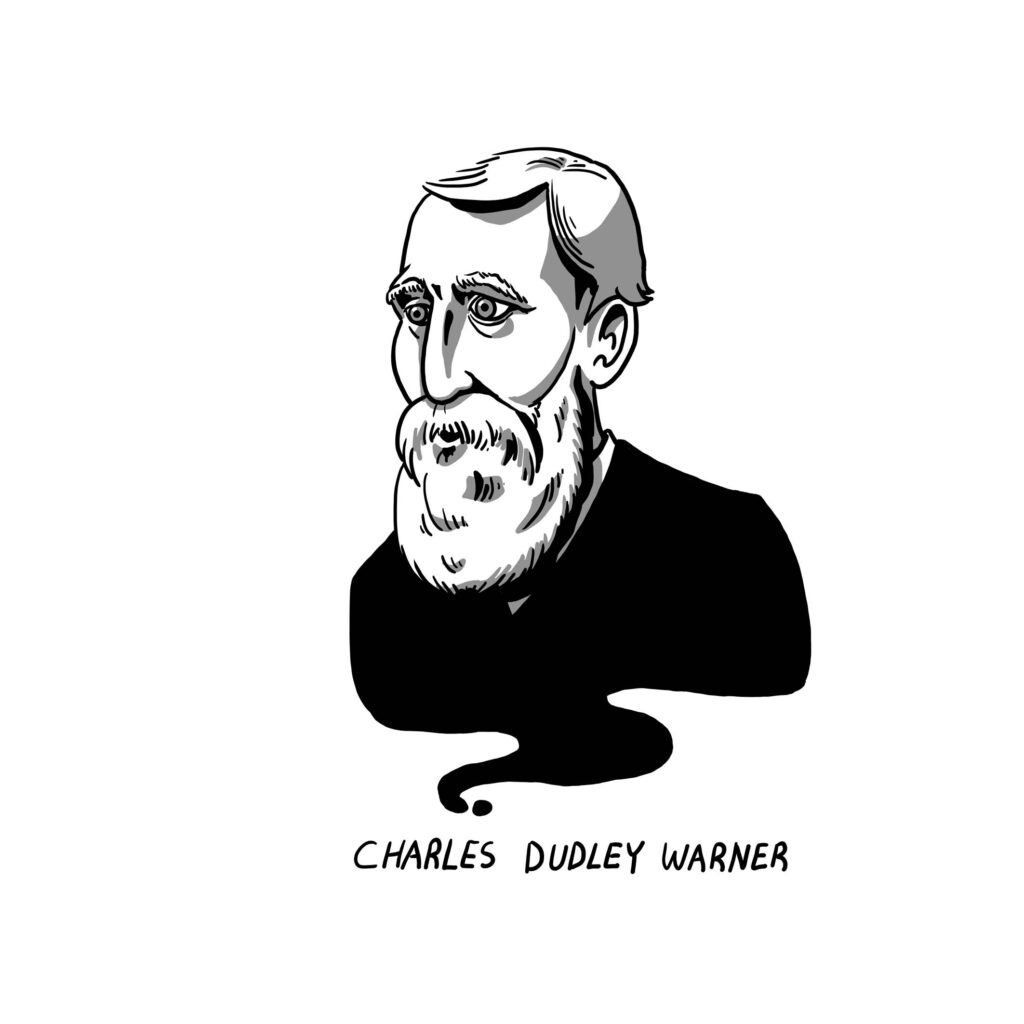
In the life of generations…the most potent and lasting influence for a civilisation that is worth anything… is that which I call literature.
–Charles Dudley Warner
Charles Dudley Warner is one of Hartford’s most influential and least-known authors. As both a writer and editor, Warner had a significant impact on literature and culture in his own day—and his Hartford residence was critical to that.
Being a Boy
Charles Dudley Warner was born on September 12, 1829 to Justus and Sylvia Warner, farmers in the hardscrabble hill town of Plainfield, Massachusetts. Justus died when Charles was five and his brother George was just a year old. Sylvia ran the farm herself for three years before selling it and rejoining her family, who lived 200 miles to the west in Cazenovia, New York. Charles stayed behind, boarding in Charlemont, Massachusetts.
This period became the subject of his 1877 memoir, Being a Boy, a nostalgic account of rural New England life. Warner described good food, heavy labor, access to books, and an old-fashioned religious atmosphere. It also showed his wry sense of humor, opening with the lines,
One of the best things in the world to be is a boy; it requires no experience, though it needs some practice to be a good one. The disadvantage of the position is that it does not last long enough; it is soon over; just as you get used to being a boy, you have to be something else[.]
At twelve, he reunited with his family in Cazenovia. As a teenager, the precociously-literary Warner set type for a printer and worked in both a post-office and a bookseller’s. His savings, along with money from the sale of the family farm, paid for him to attend Hamilton College in nearby Clinton, New York. He published his first articles while at college, graduating in 1851.
After two years surveying railroads in Missouri, he moved to Philadelphia, where he worked in conveyancing and studied law at the University of Pennsylvania. He also married musician Susan Lee (1838-1921), who had seen him give the graduation address at Hamilton. They moved west to Chicago, where Warner started a legal practice with a college friend.
His Summer in a Garden
In 1860, another lawyer and Hamilton graduate, Joseph Hawley (1826-1905), offered Warner a position as an editor of the Hartford Evening Press, an anti-slavery newspaper Hawley had founded three years earlier. The Warners moved to Hartford, where they would live the rest of their lives. There they joined the remarkable Nook Farm community. Other writers there included Harriet Beecher Stowe (1811-1896) and her husband Calvin Stowe (1802-1886), a noted biblical scholar. Its politicians and campaigners include her sister Isabella Beecher Hooker (1822-1907) and Hawley himself (who later became Governor of Connecticut and a U.S. Senator). Nook Farm had been founded by anti-slavery activists and brothers-in-law Francis Gillette (1807-1889) and John Hooker (1816-1901), husband of Isabella Beecher Hooker. Charles’ younger brother George moved to Nook Farm as well, marrying Elizabeth Gillette (1838-1915), daughter of Nook Farm founders Francis and Elizabeth Hooker Gillette (making George Warner the brother-in-law of the playwright William Gillette profiled in this collection).
In 1867, Hawley bought the Hartford Courant and merged it with his Hartford Evening Press. Warner began a series of newspaper columns humorously describing his attempts at gardening. A religious joke in the first installment established the flavor of the pieces:
The principal value of a private garden is not understood. It is not to give the possessor vegetables or fruit…but to teach him patience and philosophy and the higher virtues, hope deferred and expectations blighted….The garden thus becomes a moral agent, a test of character, as it was in the beginning.
In 1870, Warner published these columns as My Summer in a Garden, the book that received the most praise in his lifetime. When President Ulysses S. Grant visited Hartford, Warner reported one squash “was nearly all leaf and blow, with only a sickly, crook-necked fruit after a mighty fuss. It reminded him of the member of Congress from…; but I hastened to change the subject.” The most famous of Warner’s quotations, and one which is rarely attributed to him, comes from this book as well. Because one garden bed contained two varieties of fruit, Colfax strawberries and Doolittle raspberries, Warner noted that “politics makes strange bedfellows,” a joke about Vice President Schuyler Colfax, a Republican, and James R. Doolittle, a Democratic rival. This quotation has long outlived its origins and context.
Backlog Studies in the Gilded Age
In 1873, a new couple entered Nook Farm: Samuel and Olivia Langdon Clemens (1845-1904). Better known by his penname of Mark Twain (1835-1910), he and Warner shared key friends, including the local minister, Joseph Twichell, and Boston’s William Dean Howells, editor of the influential Atlantic Monthly. Warner and Twain quickly became close. Twain appears as the sarcastic, irreverent character of “Our Next-Door Neighbor” in Warner’s Backlog Studies, a book that chronicles Nook Farm’s serious, intellectual, and mixed-gender fireside conversations.
Warner and Twain soon collaborated on what became the 1873 novel The Gilded Age: A Tale of Today. It had its origin as dinner-party banter, where Samuel Clemens and Charles Dudley Warner teased their wives, Oliva Clemens and Susan Lee Warner, about the supposed poor quality of their reading. The two women challenged their husbands to write something better. Both authors wrote in their own homes and in the evenings the couples gathered; Warner and Twain read their days’ work aloud and Olivia and Susan gave feedback, shaping the novel. Afterwards, Susan played the piano for them (as also featured in Backlog Studies); she was a renowned pianist and a lecturer on music.
Warner’s fame today, such as it is, mostly rests on being Mark Twain’s coauthor. Although the book itself is little-read, the term “The Gilded Age” is used to describe the whole period of American history in the decades after the Civil War. Gilding is applying gold paint in order to make something ordinary appear expensive. In contrast to a “Golden Age,” Twain and Warner described the America of their adulthoods as appearing to be more successful than the reality—surface shimmer obscuring hidden problems.
Many Little Journeys in the World
In addition to the works already mentioned, Warner eventually published three novels of his own, including the popular A Little Journey in the World (1889). He also produced nine volumes of travel writing, chronicling time in Mexico, the American South, Europe, the Middle East, Nova Scotia, and California, which he described as Our Italy. In honor of Warner’s favorable description of San Diego in Our Italy, the city returned the favor by naming three parallel streets Charles, Dudley, and Warner Streets. His travel even shaped the Warners’ Hartford home, described as full of exotic décor, including a mantlepiece of historic middle eastern tiles set in California redwood.
There is much about him that is ultimately ephemeral. He was a prolific journalist in an era when most newspaper articles went unsigned. He wrote not only for the Hartford Courant, but also contributed to major arbiters of American literature, such the Atlantic Monthly and Harper’s Magazine, where he was an editor from 1886 to 1898. He edited a 45-volume series of The World’s Best Literature.
Numerous friends noted his insights and humor as a conversationalist. Indeed, although the wonderful quip “Everybody talks about the weather but nobody does anything about it” is usually attributed to Mark Twain, it seems that it was probably Warner’s joke. His own writing was humorous, in a gentle, softly ironic tone. While passages still produce chuckles, his prose style is out of favor and the subjects are dated, so his subtle satire is rooted in references that are hard to grasp today.
Hartford was key to Charles Dudley Warner. He was part-owner and editor of the Hartford Courant for decades. Nook Farm gave him and Susan Lee Warner a wide circle of literary friends. He was a member of the Monday Evening Club, an important intellectual discussion group in the city. He was also closely involved in events, clubs, and societies in Boston and New York, taking advantage of Hartford’s geography. My Summer in a Garden and Backlog Studies remain invaluable records of intellectual conversations and political attitudes in Hartford at this time. He died on October 20, 1900.
Warner was cherished by others who went on to become more famous. The last time Mark Twain visited Hartford was to attend Warner’s funeral. The bantering tone of much of Warner’s writing belies his seriousness and his commitment to the craft. As he described, “in the life of generations…the most potent and lasting influence for a civilisation that is worth anything… is that which I call literature.”
Anthology Selections
“Calvin, a Study in Character,” from My Summer in a Garden (Boston, 1871).
Backlog Studies – excerpts (Boston, 1872)
“The Sugar Camp,” from Being a Boy (Boston, 1877)
“Social Screaming” and “Dinner-Table Talk” from As We Were Saying (New York, 1891)
Charles Dudley Warner – Biographical and Critical Sources
—-
Editor’s Note to Self: the following introductions should be added to the selections when they are formatted and removed from this page.
“Calvin, a Study in Character,” from My Summer in a Garden (Boston, 1871).
This essay is an extended joke. The title makes the reader think they will get a boring biography of John Calvin (1509-1564), a theologian and leader of the Protestant Reformation. Instead, this is a profile of an interesting and unusual resident of Nook Farm. Can you discover why this Calvin seems slightly different? How does Warner’s writing lead us to think Calvin is something they are not?
“Third Study” from Back Log Studies (Boston, 1872)
This extended dialogue is Warner’s attempt to capture the tone of Nook Farm conversations. This debate is over the nature of novels and especially female authors, who were rising in popularity during this period. The Fire-Tender is Charles Dudley Warner, the Mistress is Susan Lee Warner, Our Next-Door Neighbor is Mark Twain, and the Parson is the Rev. Joseph Twichell, pastor of Asylum Hill Congregational Church (which they attended).
“The Sugar Camp,” from Being a Boy (Boston, 1877)
Warner wrote this memoir about his childhood in poor, rural Massachusetts while living in prosperous, urban Hartford. Along with nostalgic descriptions of making maple sugar in the spring, Warner makes some comments on the commercialism of his adulthood versus the perceived innocence of his childhood before the Civil War and the era of big business that he and Mark Twain satirized in The Gilded Age.
“Social Screaming” and “Dinner-Table Talk” from As We Were Saying (New York, 1891)
In these two short essays, Warner discusses normal behavior at occasions that ought to be fun: a party and a dinner. However, Warner uses a formal tone and over-analyzes the situations for comedic effect. This is a technique used by comedians to this day. However, Warner wrote at a time when anthropology was a new academic discipline and numerous public societies were dedicated either to studying civilizations or trying to reform public morals and campaign for social causes. Warner’s satire is to turn this kind of analysis back on mundane, unproblematic aspects of society.