
Prejudice is Hating the Image of God
by Steve Courtney
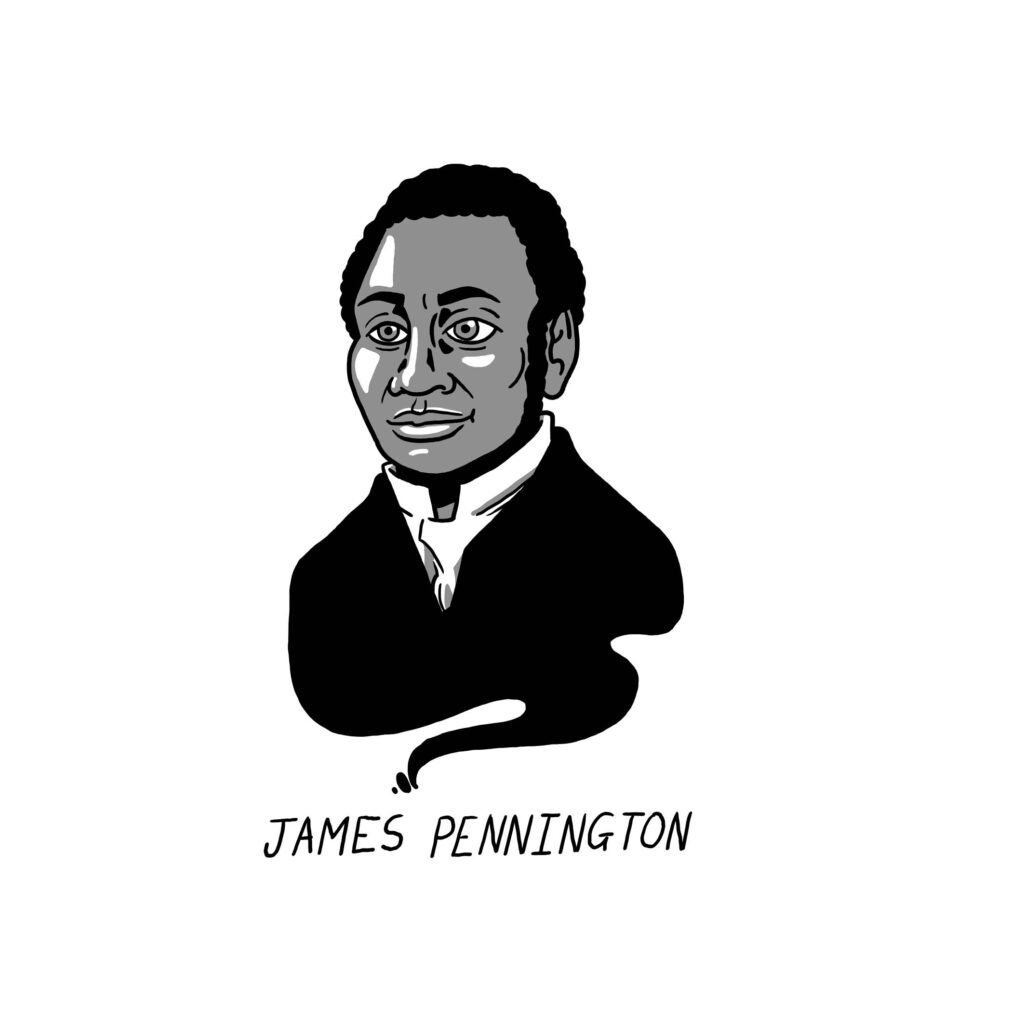
Of the many narratives of enslaved people that were published in the interest of abolition in the early 19th century, there were few in which an escapee wrote to his former owner years later to give him a piece of his mind.
But such a letter was written by the Rev. James W. C. Pennington of Hartford, circa 1844, to aging plantation owner Frisby Tilghman of Maryland, still legally his “master”: “I called you master when I was with you by the mere force of circumstances; but I never regarded you as my master….You struck me with your walking cane, called me insulting names, threatened me, swore at me….You are soon to meet those you have held, and do hold, in slavery, at the impartial bar of the impartial Judge of all who doeth right.”
It was only seventeen years since Pennington had left his blacksmith forge on the plantation and fled to freedom. By now he was an accomplished anti-slavery orator, the pastor of Hartford’s respected Talcott Street Church, and a delegate to a World Anti-Slavery Convention in London the year before. He had studied at Yale and was a few years away from an honorary Doctor of Divinity degree at the University of Heidelberg in Germany. But his legal status—which he had kept a secret—was that of a fugitive slave.
Fugitive Blacksmith
James William Charles Pennington was born James Pembroke at Tilghman’s father’s plantation in 1807. He had, with his mother, been given to Frisby Tilghman and his bride as a wedding present when James was about 4 years old. He was hired out to a stonemason and then apprenticed to an enslaved blacksmith, who found him to be a quick study. But one morning he witnessed his father beaten by Tilghman; “I never was a Slave after it,” he writes.
His escape took him to Pennsylvania, where he was taken in by white Quaker families. Here he began his education—learning to read and speak out (in a barn, by himself, at first). A move to Brooklyn, N.Y., brought him employment with another family, this one Presbyterian, who encouraged his studies and where he went through both a Christian spiritual awakening and a deeper realization of the enormity of slavery. Pennington—he had changed his name after his escape—married, taught in an “African” school, and studied for ordination into the ministry. In the mid-1830s he was able to study at Yale Divinity School with the aid of New Haven abolitionists—but in an extremely limited way. He could attend classes, but “my voice was not to be heard in the classroom asking or answering a question. I could not get a book from the library and my name was never to appear in the catalogue.” (It was not until 2023 that, thanks to a group of determined Divinity School students, he was awarded a Master of Arts posthumously.)
Pennington was ordained back in New York in 1838—and was soon after called to perform the wedding of another escapee from slavery, Frederick Douglass, and Ann Murray, who had financed Douglass’s escape.
This was the era of national anti-slavery conventions that were the seedbed of the abolitionist movement, and Pennington had joined in with a vengeance. In the late 1830s he heard much of the legal battles of the Amistad mutineers and, in New York, he joined many of his anti-slavery colleagues in opposing “colonization,” the idea that freed slaves could never be absorbed into white American society and should be returned to Africa. “I am an American to the backbone,” he wrote.
His first major speech was at an 1839 event celebrating the anniversary of the abolition of slavery in the British empire. “In proportion as British influence prevails in this land,” he said, speaking of America, “oppression will continue to feel the effect of this event until it is dead! dead!! DEAD!!!” The power of his oratory won him fame in the world of anti-slavery activism, and in 1840 came the ministerial call to the Talcott Street Church in Hartford.
Polemics from the Pulpit
The city was a river port town of 10,000 people, with a black population of about 500. The church had been founded by African Americans tired of crowding into the segregated pews and balconies of the white churches. Pennington assumed the role of pastor and also served as headmaster of the school for the city’s Black children that met in the church’s small basement. Among his parishioners were Ann Plato, the poet—Pennington wrote an introduction to her book published in Hartford in 1841—and James Mars, who had suffered under Connecticut slavery in its waning days. It was in 1841, early in his eight-year Hartford stay, that he published A Text Book on the Origins and History, Etc., of the Colored People, the first book to record the history of African Americans. The book makes arguments from the Bible to counter pro-slavery biblical propaganda: How could African Americans be descended from Cain, for example, when any such descendants would have been drowned in the Flood? But the book goes on to make logical, precise, and eloquent arguments for African, and thus African American, equality of intelligence, while acknowledging that prejudice, enslavement, and degradation had held the race back. “Prejudice,” he said, “is hating the image of God.” Examples of such hatred he provided included the racist attack on Prudence Crandall’s school in Canterbury, Connecticut.
Pennington used his pulpit to condemn the institution whenever he could, once turning a Thanksgiving sermon into a polemic against what he called “a covenant with hell.” New England and New York groups chose him as a delegate to the Second World Anti-Slavery conference in London. Though he was lauded there and on travels in England, when he boarded an American ship to return, he was relegated to an inferior cabin despite holding a first-class ticket.
In Hartford he made the acquaintance of John Hooker, the abolitionist lawyer, who was married to Isabella Beecher Hooker, the famed feminist, suffragist, and spiritualist. In 1844 he confessed to his friend that he was a runaway slave—something he had not even told his wife. Making him legally “free” would relieve him of uncertainty, because even in a Northern state he could be at risk.
Hooker got in touch with Tilghman, Pennington’s “owner,” and tried to buy the pastor and his still-enslaved parents, but the price was too steep. This was when Pennington wrote the “impartial Judge” letter to Tilghman. It wasn’t until after Tilghman’s death that Hooker, in 1850, was able to get the administrator of his estate to let Pennington go for a more reasonable price. Pennington was back in England at the time, worried about returning at all because the Fugitive Slave Law had made it easier for Southern slave hunters to retrieve their “goods” in the North. Hooker “freed” Pennington after a half-hour during which, he said, with tongue in cheek, he savored the sensation of owning a Doctor of Divinity.
War in New York
Such whimsy, however, belied the seriousness of the deteriorating situation in the United States leading up to the brutal Civil War. Pennington had left Hartford by 1850, following a new call to the Shiloh Presbyterian Church in New York. The same year Pennington published his vivid and passionate memoir of slavery and escape, The Fugitive Blacksmith. In wrapping up near the conclusion he writes:
The only harm I wish to slaveholders is that they may be speedily delivered from the guilt of a sin which, if not repented of, must bring down the judgment of Almighty God upon their devoted Heads. The least I desire for the slave is, that he may be speedily released from drinking a cup whose bitterness I have sufficiently tasted, to know that it is insufferable.
The New York years brought him national prominence, as he continued his work with the anti-slavery conventions and his eloquent oratory, sharing platforms with the likes of Douglass, Gerrit Smith, and James McCune Smith. They also included an early foreshadowing of the 20th century civil rights movement when Elizabeth Jennings, a young organist on her way to church on a Sunday, was forcibly removed from a streetcar because of her race. Sticking to her guns, Jennings won her court case, ending segregated public transportation in New York—but as with the civil rights movement, that end came slow and reluctantly. Pennington, who had supported Jennings’ cause, was himself later ejected from a streetcar and lost his lawsuit against the company despite the law.
When the Civil War came Pennington advocated and supported the enlistment of African Americans. Although he was out of the city at the time, he saw the aftermath of the murderous race riots triggered by the introduction of the draft in New York City.
After the war he spent time in ministries in Natchez, Mississippi, and Portland, Maine, and finally in Jacksonville, Florida, where he died in 1870, ministering to those who, like him, had been born as the property of others.
Anthology Selections
A Text Book of the Origin And History, Etc. Of The Colored People (excerpts)
To the Reader (preface to Ann Plato’s book)
God is No Respecter of Persons