
Poet, Editor, and Advocate for Connecticut Poetry
by Amanda M.B. Matava
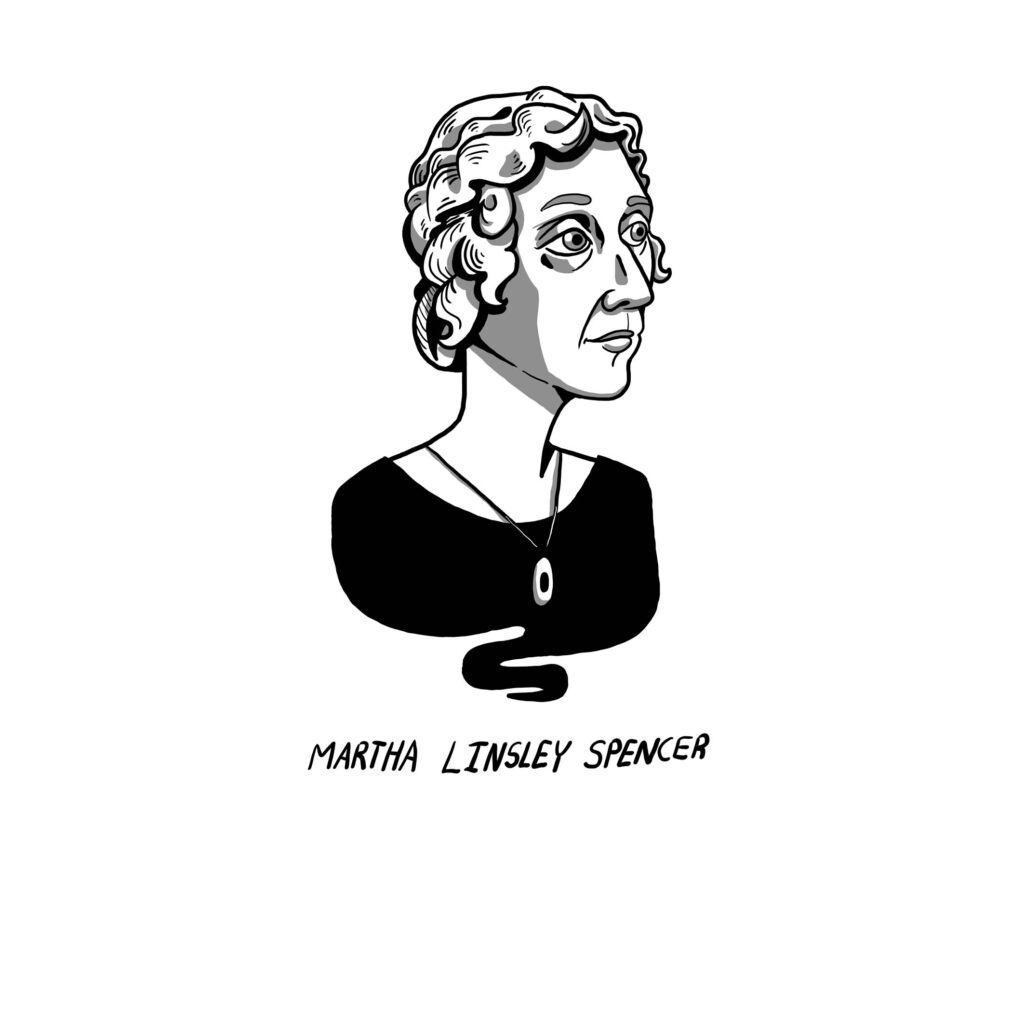
Martha Linsley Spencer was a Connecticut poet, literary editor, and arts organizer who played a central role in nurturing the state’s poetry community during the first half of the twentieth century. Best known as editor of the Hartford Times poetry column and as a leader of the Hartford Poetry Club, Spencer devoted much of her career to amplifying the voices of other poets while quietly producing a substantial body of her own work.
Early Life and Education in Connecticut
Martha Linsley Spencer was born on October 28, 1875 in Lebanon, Connecticut to Francis Spencer and Esther Ann Linsley in the home owned by her grandfather George Dyer. The home previously belonged to Jonathan Trumbull Jr., son of “Brother Jonathan” Trumbull Sr., both of whom served as governors of Connecticut. She had one sister, Esther, and four brothers: Francis, George, B. Halsey, and Charles.
Spencer lived in the Dyer home until her grandparents moved to Deep River, where she attended high school. She later graduated from Vermont Academy and Emerson School of Oratory in Boston, Massachusetts, where she studied rhetoric and dramatic teaching. This training carried her into work as dramatic instructor at the House of the Good Shepherd and dramatic arts teacher at West Middle School, Noah Webster School, and Hall High School. Spencer also enjoyed what was then called “platform work”—putting on events, performances, and ceremonies such as graduations. She never married and devoted her adult life to teaching, editing, and literary work. For many years, she lived at 73 Evergreen Avenue in Hartford, Connecticut.
Editor of the Hartford Times Poetry Column
According to a tribute by Margaret Thomas Johnston, Spencer’s “profound knowledge” of rhetoric and experience as a poet prepared her for her work as literary editor of the Hartford Times’ poetry column titled “The Poet’s Corner,” a post she held for 25 years. The Poet’s Corner was initially an outlet for poetry by members of the Hartford Poetry Club but soon began featuring poets from “every state in the union,” from amateurs to the renowned. As editor, Spencer read each work from the piles of poetry that arrived at her desk “with evaluating attention” and selected those pieces that would be published in the column. Spencer was conscientious and considerate of the poets who sent submissions, offering editorial advice, critique, and praise—both to encourage those who were not chosen and to celebrate those who were.
Spencer also spent over three decades as a devoted member, chairperson, and President of the Hartford Poetry Club, founded in 1921. Spencer corresponded with and helped bring poets to Connecticut to lecture and instill a love of poetry in others. The Club fundraised to save the Mark Twain House and Memorial and procured autographed editions of poetry by Connecticut poets. Members also attended lectures and studied with Robert Hillyer, Assistant Professor of English at Trinity College.
Spencer’s efforts and communications brought such poets as Edna St. Vincent Millay, W.B. Yeats, and Robert Frost to Connecticut for public events. Spencer helped sponsor the creation of an annual poetry day in Connecticut, celebrated October 15, and was honored at the Club’s 30th anniversary meeting on April 18, 1951. The Poetry Club voted to disband on June 10, 1953 “with dignity.”
Poetry and Artistic Work
As she received, edited, and critiqued poetry from local aspirants, Spencer was a prolific poet herself, penning thousands of free-verse works with a variety of aliases, such as her own initials “M.L.S.,” or reversed “S.L.M.” However, “Abbie Jones” was the pen name that “held the essence of her poetry,” according to Johnston.
Spencer’s poems spanned many subjects—seasons and months (especially Christmas), flowers and trees, remembrances for fellow poets and family members, and the Second World War. She was inspired through observations of everyday life, current events, and the things around her that invoked feeling.
“Pastel in Gray” describes a cloudy sky as “softer than mother-of-pearl” and the Traveler’s Tower in Hartford “pricked with golden-lighted windows.” “After School” details a conversation between two girls—one asking about the other’s culture and language. Two poems on World War II “America to Holland” and “The Hour” were, respectively, honored by Queen Wilhemina of the Netherlands and Lord Halifax of England.
Spencer did not, however, just paint in words. She enjoyed the physical medium, too, especially watercolors and pastels, and often painted small scenes to accompany her poems.
In 1932 the Troubadour, a San Diego-based poetry magazine, published an issue devoted to Connecticut poets called “A Connecticut Number” in which Spencer’s featured poem “Scoria” won the free verse award. Her short story “Nutmegs are Wooden,” which tells the story of how Connecticut became the Nutmeg State, was published in Yankee Magazine in April 1947.
For many years, Spencer’s friends and family tried to convince her to publish her poems, but she was engaged with supporting other aspirants through her column and the Club. Additionally, as Johnston reports, “she could not decide what to choose from literally ‘one thousand poems.’” When the Poetry Club voted to disband in 1953, its last official act was to approve funding for the publication of Spencer’s poems.
Later Recognition and Legacy
Martha Linsley Spencer passed away on July 17, 1954. Later that year, her only book of poetry, Remembered Years: Collected Poems, was published posthumously in a limited edition of 500 copies. The volume features ten sections of poems accompanied by illustrations Spencer herself designed, offering a representative selection of her work.
Also in 1954, Spencer’s library of 729 volumes and her personal papers were donated to Trinity College by her sister, in accordance with Spencer’s wishes. Today, her legacy endures through these materials, which remain available to researchers and the public at Trinity College’s Watkinson Library.
As Margaret Thompson Johnston observed, “Who but the poet Martha Linsley Spencer could have found such beauty from only the windows of an apartment, and such contentment within its walls that harbored her ancestral heirlooms?”