
Modern Poet of New England Regionalism
by Eric Stoykovich
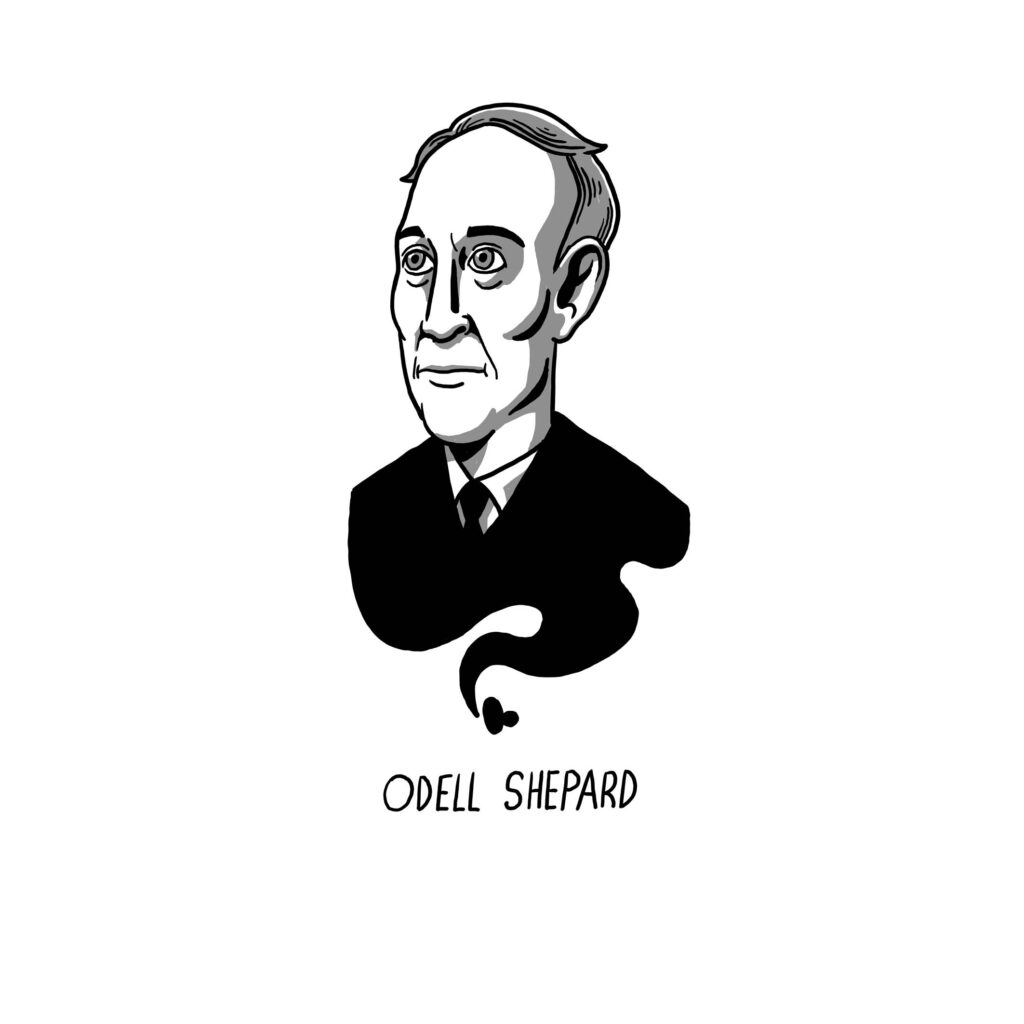
The Path to Hartford
Sometimes a writer loves a place or a country even if they were not born there. Such was the case with (William) Odell Shepard in relation to Connecticut. He was born in July 1884 into a minister’s family in Illinois, where the writing of New England transcendentalist Henry David Thoreau may have inspired Shepard at age nine. At age 16, he left home to study music at Northwestern School of Music, training as a pianist and pipe organist. Enrolling in 1904 at the University of Chicago, he completed a bachelor’s degree in philosophy. There he added a Master of Philosophy degree in 1908, the same year he married Mary F. Record. Their only child, Willard Odell Shepard, was born in 1914.
Interested in writing and music, he took jobs reporting and editing for newspapers, as well as one playing organ for a church. Between 1909 and 1914, Shepard taught English as a professor at the University of Southern California. He moved his family to Massachusetts to attend graduate school at Harvard and he graduated with a PhD in 1916. Months after the United States entered World War I, in the spring of 1917, Dr. Shepard took up the inaugural J.J. Goodwin Professorship of English at Trinity College, a private liberal arts college in Hartford. Known for speaking in a soft voice and nicknamed “Bard” by students, he taught Shakespeare, contemporary British literature, and American literature at Trinity until 1946.
Becoming a New England Regionalist: Poetry and Language
During and after World War I, Odell Shepard won public recognition for his poetry and essay-writing, which were popular literary forms read by college graduates in America at the time. As intellectuals and artists of the 1920s grappled with the end of the free and peaceful movement of capital and humanity across the world, some came to view the United States as a land of multiple irreducible regions. Regional writers with middle-class backgrounds, like John Crowe Ransom and Willa Cather, argued that poetry—or prose masked as poetry—could be the first step in the economic revival of a region. In his 1921 edition of Thoreau’s A Week on the Concord and Merrimack Rivers, Shepard praised “Thoreau’s enduring love of place—that sentiment from which all patriotism springs and circles outward.” Beginning with his move to Hartford in the fall of 1917 until the rest of his life, Odell Shepard wrote and opined about the beauty and boundlessness of small, quiet places in New England, but most especially Connecticut.
Publishing short pieces in various literary magazines and newspapers, Shepard reached the audiences of The Christian Science Monitor, Scribner’s Magazine, and other subscription magazines, which arrived regularly via the postal service to homes across the country. Though targeted at a national audience, periodical nonfiction was a way for keen-eyed writers to critique what Shepard and Robert Hillyer described as “national manners, speech, education, [and] commercialism,” which many regionalists deemed to be threats to the local color, sound, and variety of regions across the country. He corresponded with active writers including Hartford’s Wallace Stevens.
Connecticut’s Rural Towns and Wild Places
Like New England’s transcendental poets of the 19th century, Shepard studied “nature, books, and men.” These were his main subjects. Through the act of meeting and conversing with the people of Connecticut about their daily lives, he could hear and observe what he saw as the distinctive lifeways of the state, which could be represented through prose and verse. Most of his essays communicated a love of common people. Shepard winnowed the best social criticism written by other authors and presented those literary grains in anthologies, such as his edited volume Essays of 1925. Known for his encouragement of students, Shepard taught and mentored award-winning poet Hyam Plutzik, a 1932 Trinity graduate.
Shepard’s love of the people and landscapes of Connecticut shines through his three compilations of essays and poems: The Harvest of a Quiet Eye (1927), “The Cabin Down the Glen” (written in stages in the early 1930s, but unpublished until 2006), and Connecticut Past and Present (1939). In 1937 he published Pedlar’s Progress: The Life of Bronson Alcott, a biography of the most famous Connecticut-born transcendentalist of the 19th century. It won Shepard the Pulitzer Prize in 1938. Three years later, he attended and spoke at the first meeting of the Thoreau Society of America, now the oldest organization devoted to an American author.
Harvest of a Quiet Eye is a digressive narrative of his two-week ramble on foot across the rural northern tier of Connecticut starting in Brooklyn in the East through to Salisbury on the border with New York state. Shepard cast his eyes over Connecticut’s farms, which had declined in number and value by the early 20th century, thereby causing forest to overtake many farms. Harvest generated appreciative fan mail from readers. “The Cabin Down the Glen” is a forest idyll written from the solitude of a snug cabin on twenty-odd acres in Riverton, Connecticut. It is an homage to the time that Thoreau spent on Walden Pond. Approaching 50 years old, Shepard urged Americans to look inward, thereby addressing the emptiness and callousness of modern society through quiet reflection. Shepard believed that each individual human soul, one at a time, had to come into contact with Nature and that a return-to-nature did not have to alienate oneself from humanity.
The idealism and spirituality of “Cabin” is contrasted with the tongue-in-cheek tone of Connecticut Past and Present. That book was modeled on several comprehensive guides to the historical and tourist sites of Connecticut which had appeared during the Depression of the 1930s, including the Federal Writers Project’s Connecticut: A Guide to its Roads, Lore and People (1938). Poking fun at guidebooks while imitating them, Shepard incorporates hundreds of facts and figures, but undercuts many of them with a subtle, dry humor, leaving the reader struggling to distinguish history from fiction. Well-regarded by readers, Connecticut Past and Present makes the case that Connecticut’s beating heart is its proudly independent towns.
Views of Cities, Immigrants, and Indigenous Peoples of Connecticut
Odell Shepard’s praise of “old Connecticut” was linked to his dismay at unregulated mills and millionaires, as well as complaints about automobile traffic along the newly created Merritt Parkway. Rhetorically, he had Thomas Jefferson’s distaste for cities as sources of decay mixed with Thorstein Veblen’s critique of consumption. Yet he did not fear social change entirely. The arrival of immigrants to Connecticut had surely made the state different, but with time those “newcomers” would adopt the “steady habits” of frugality and industry, just as Shepard did after moving to New England.
While some of his portraits of people (or specific groups) would be considered unacceptably racist or misogynist today, Shepard was not unlike many college-educated white men of his time. In at least some of his writings, Blacks and most immigrants to New England other than the English had minor, or merely supporting, roles to play in Connecticut’s intellectual or political life. In 1940, he was asked to stand for election as a Democratic candidate as Connecticut’s Lieutenant Governor. Winning the election, he took time off from teaching to serve in government for two years from 1941 to 1943.
Remarkably for the era in which he was writing, his portraits of Native Americans in Connecticut depict them as multifaceted people who are the legitimate owners of the land. Though Shepard thought that people who descended from English-speaking lands would remain culturally dominant in the region, he was in contact with living indigenous people. As Lieutenant Governor, Shepard helped encourage a petition signed by 170 Mohegans, seeking $50 million to compensate them for the sale of their lands beginning in the 18th century. In August 1941, Shepard spoke and drummed at the 76th annual corn festival of the Mohegans in Montville; the event was so popular that it caused traffic jams.
After World War II ended, Shepard’s views shifted as he became active in the American Civil Liberties Union. In 1946, he moderated a faculty-student discussion entitled “Prejudice in American Life.” According to the college’s newspaper, he said that “racial prejudice is based upon bad thinking; it is pre-judgment of the facts.” During the McCarthy anti-communist campaigns, he had to defend against false charges that he was supportive of Communism.
Solitude and Slowing Down
In 1946, at the age of 62, Professor Shepard felt worn out and asked for a sabbatical from the college’s administration. The request was apparently rejected, so he resigned his post as English Professor after nearly three decades in the classroom. That year Shepard co-authored, with his son Willard, the second of his two most popular books. They were the historical romances Holdfast Gaines (1946) and Jenkins’ Ear (1951). During the 1950s, he wrote a 15-minute segment on utopia for the radio program “The American Story” and taught one year at Suffield Academy, as his pace of writing slowed down. In 1951, he fought successfully the passage of a bill in the Connecticut legislature that would have allowed the state to take private property for development of a steel mill near his home on Jordan Cove in Waterford, arguing that “if they can kill a town here, they can murder a town anywhere. And the next place to go might be West Hartford.”
Reflecting back on his life with his humor intact, Shepard wrote about himself that “his major interest has been in what he calls ‘the history of solitude,’ and on that topic he has never published one word.” In July 1967, New England’s witty poet of regionalism Odell Shepard died. He donated his body to Yale Medical School; his manuscripts went to Trinity College. His heart remains with Connecticut.
Anthology Selections
“In the Dawn” (poem, 1918, link to Hathi Trust)
The Harvest of a Quiet Eye: A Book of Digressions (book, 1927, link to Hathi Trust)
The Lore of the Unicorn (book, 1930), Chapter VII: Rumours
The Cabin Down the Glen (Cincinnati: Rick Sowash Publishing Co., 2006). This PDF is offered by publisher Rick Sowash as a free digital download by the public.
Recommended Chapter: “Living Alone”